Bernard of Clairvaux, Date of Birth, Place of Birth, Date of Death
TweetBernard of Clairvaux
French abbot, theologian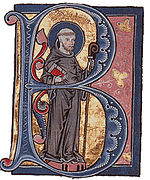

 Date of Birth:
  Place of Birth: Dijon, Bourgogne-Franche-Comté, France
About Bernard of Clairvaux
- Bernard of Clairvaux (Latin: Bernardus Claraevallensis; 1090 – 20 August 1153) was a French abbot and a major leader in the reform of Benedictine monasticism that caused the formation of the Cistercian order. "...He was sent to found a new abbey at an isolated clearing in a glen known as the Val d'Absinthe, about 15 kilometres (9.3 mi) southeast of Bar-sur-Aube.
- According to tradition, Bernard founded the monastery on 25 June 1115, naming it Claire Vallée, which evolved into Clairvaux.
- There Bernard preached an immediate faith, in which the intercessor was the Virgin Mary." In the year 1128, Bernard attended the Council of Troyes, at which he traced the outlines of the Rule of the Knights Templar, which soon became the ideal of Christian nobility. On the death of Pope Honorius II on 13 February 1130, a schism broke out in the church.
- King Louis VI of France convened a national council of the French bishops at Étampes in 1130, and Bernard was chosen to judge between the rivals for pope.
- By the end of 1131, the kingdoms of France, England, Germany, Portugal, Castile, and Aragon supported Pope Innocent II; however, most of Italy, southern France, and Sicily, with the Latin patriarchs of Constantinople, Antioch, and Jerusalem supported Antipope Anacletus II.
- Bernard set out to convince these other regions to rally behind Innocent. In 1139, Bernard assisted at the Second Council of the Lateran.
- He subsequently denounced the teachings of Peter Abelard to the pope, who called a council at Sens in 1141 to settle the matter.
- Bernard soon saw one of his disciples elected Pope Eugene III.
- Having previously helped end the schism within the church, Bernard was now called upon to combat heresy.
- In June 1145, Bernard traveled in southern France and his preaching there helped strengthen support against heresy.
- He preached at the Council of Vézelay (1146) to recruit for the Second Crusade. After the Christian defeat at the Siege of Edessa, the pope commissioned Bernard to preach the Second Crusade.
- The last years of Bernard's life were saddened by the failure of the crusaders, the entire responsibility for which was thrown upon him.
- Bernard died at the age of 63, after 40 years as a monk.
- He was the first Cistercian placed on the calendar of saints, and was canonized by Pope Alexander III on 18 January 1174.
- In 1830 Pope Pius VIII bestowed upon Bernard the title "Doctor of the Church".
Read more at Wikipedia
See Also
- Famous People's Birthdays on 01 January, France
- Famous People's Birthdays in January, France
- Famous writer's Birthdays on 01 January, France
- Famous writer's Birthdays in January, France
- Famous theologian's Birthdays on 01 January, France
- Famous theologian's Birthdays in January, France
- Famous religious servant's Birthdays on 01 January, France
- Famous religious servant's Birthdays in January, France
- Famous philosopher's Birthdays on 01 January, France
- Famous philosopher's Birthdays in January, France
- Famous hymnwriter's Birthdays on 01 January, France
- Famous hymnwriter's Birthdays in January, France