Jan Žižka, Date of Birth, Place of Birth, Date of Death
TweetJan Žižka
Czech general
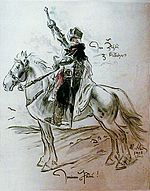

 Date of Birth: 01-Jan-0001
 Place of Birth: Památník Jana Žižky z Trocnova, South Bohemian Region, Czech Republic
Date of Death: 11-Oct-1424
Profession: military leader
Nationality: Czech Republic
Zodiac Sign: Capricorn 
About Jan Žižka
- Jan Žižka z Trocnova a Kalicha (Czech pronunciation: ['jan '???ka] (listen); German: Johann Ziska; English: John Zizka of Trocnov and the Chalice) (c.
- 1360 – 11 October 1424) was a Czech general, a contemporary and follower of Jan Hus, Hussite military leader, and later also a Radical Hussite who led the Taborites.
- Žižka is held to be one of the most renowned military leaders by many historians and today he is widely considered a Czech national hero. He was born in the small village of Trocnov (now part of Borovany) in the Kingdom of Bohemia into an aristocratic family.
- He was nicknamed "One-eyed Žižka".
- From his youth, he was attached to the royal court and held the office of Chamberlain to Queen Sofia of Bavaria.He fought in the Battle of Grunwald (July 15, 1410), where he defended Radzyn against the Teutonic Order.
- Later he played a prominent role in the civil wars in Bohemia during the reign of Wenceslas IV.
- Žižka's tactics were unorthodox and innovative.
- In addition to training and equipping his army according to their abilities, he used armored wagons fitted with small cannons and muskets, anticipating the tank of five hundred years later.
- He knew how to exploit geographic features to the full, and maintain discipline in his armies. In the Battle of Kutná Hora (1421) he defeated the army of the Holy Roman Empire and Hungary.
- The effectiveness of field artillery against the royal cavalry in the battle turned field artillery into a firm part of Hussite armies.
- Žižka is considered to be among the greatest military leaders and innovators of all time.
- His accomplishments in this regard are especially unique and noteworthy as he had to quickly train peasants to repeatedly face highly trained and armored opponents who usually severely outnumbered his own troops, and for this, some have considered him to be the greatest general in history. A monument was erected on the Vítkov Hill in Prague to honor Jan Žižka and his victory on this hill in 1420.
- It is the third largest bronze equestrian statue in the world.
Read more at Wikipedia
Image Author, Source and License
Author:
Source: La bildo estas kopiita de wikipedia:cs.
License: CC-PD-Mark
More Details
Mikoláš Aleš
(1852–1913)     |
|||
|---|---|---|---|
 |
|||
| Alternative names | Nikolaus Alesch; Nikolaus Aleš; Nikolaus Ales; nikolaus ale; nicolas ales; Mikolás Ales | ||
| Description | Czech painter and illustrator | ||
| Date of birth/death | 18 November 1852 | 10 July 1913 | |
| Location of birth/death | Mirotice | Prague | |
| Authority control | |||
Source: La bildo estas kopiita de wikipedia:cs.
License: CC-PD-Mark
More Details