Lucjan Wolanowski, Date of Birth, Place of Birth, Date of Death
TweetLucjan Wolanowski
polish writer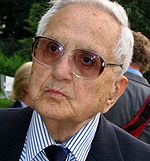

 Date of Birth:
  Place of Birth: Warsaw, Masovian Voivodeship, Poland
About Lucjan Wolanowski
- Lucjan Wilhelm Wolanowski (Lucjan Kon; February 26, 1920 in Warsaw, Poland – February 20, 2006 in Warsaw), pseudonyms: Wilk; Waldemar Mruczkowski; W.
- Lucjanski; (L.W.); lu; Lu; (lw); WOL., Polish journalist, writer and traveller. Born into an intellectual family.
- Son of Henryk Kon (lawyer) and Róza Wolanowska, the great-grandson of Majer Wolanowski (1844–1900), the well-known Polish manufacturer.
- His sister, Elzbieta (Kon) Wassongowa (1908–2007) was a Polish translator and book editor. Wolanowski studied chemistry at the Grenoble Polytechnical Institute (France 1938-1939), but the outbreak of World War II caught him during a vacation in his homeland.
- During World War II he fought as a soldier of the Polish clandestine resistance movement Home Army, and he acted as literary contributor to the Polish underground press. After the war he worked with the Polish Press Agency (from 1945); he was a commentator from various conferences for journalists in the Foreign Secretary in Warsaw.
- In this period he met such famous people as Edward R.
- Murrow, Sydney Gruson, Flora Lewis, Larry Allen, Vicent Buist or Pierre Marechal, who were correspondents in Poland then.
- He worked as a journalist at the weekly magazine Przekrój (1945–1950); the illustrated weekly Swiat (The World, 1951–1969); the magazine Dookola swiata (1969–1976) and with the magazine Magazyn Polski (1976–1988). He joined a ship-rescue operation in a Norwegian fiord, made a long trip aboard an Icelandic cutter in North Atlantic waters.
- He went on five trips around the world (1960–1972) and also visited the Pacific region – he visited Australia, Japan, New Zealand, Papua and New Guinea, West Irian, French Polynesia, Fiji, Hong-Kong and Singapore; accredited to the headquarters of the UN Troops in New Guinea during the landing operation (1962–1963); as the US stipendist (he was granted a scholarship United States Department of State - "Program for Leaders"), he belonged to the team of reporters (as the only reporter from the Eastern Bloc) to cover the take off of the space vessel Gemini 5 in 1965 (Cape Kennedy, Florida); he acted as advisor to the World Health Organization Information Department in Geneva, then in a similar capacity at the WHO branches in New Delhi, Bangkok and Manila 1967–1968.
- He traveled aboard an Australian light-house tender m.v.
- Cape Moreton, servicing light-houses on the small Coral Sea islands and took part in an Australian whaling expedition.
- Was rescued by black-trackers during his wanderings across the Kimberley desert. He wrote 25 books, translated into 7 languages and depicting mainly his travels.
- He did not specialize in economics or in politics, but always looked for "the human side of the story" and tred to see for himself the things he was going to write about.
- All his books are illustrated by pictures he shot himself. Member of the Association of Polish Journalists (1951–1982 and 1991–2006), of the Polish Writers Union (1959–1983), of the Polish PEN Club (1971–2006), of the Association of Polish Writers (1989–2006); former member of the Polish Socialist Party (PPS; 1945–1948), and of the Polish United Workers Party (PZPR; 1948–1980). Distinctions: Order of the Romania Star (1949), Award of the Polish Club of International Publicists (1962); Prize of the Polish Journalists Association for the Best Book of the Year (1973); the Cavalier's Cross of Polonia Restituta; the Golden Cross of Merit; Honorary Citizen of Springfield, United States (1965).
Read more at Wikipedia