Johannes Gutenberg, Date of Birth, Place of Birth, Date of Death
TweetJohannes Gutenberg
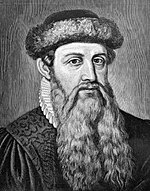
German blacksmith, goldsmith, printer and publisher

 Date of Birth: 01-Jan-0001
 Place of Birth: Mainz, Rhineland-Palatinate, Germany
Date of Death: 03-Feb-1468
Profession: engineer, inventor, goldsmith, engraver, typographer, blacksmith
Zodiac Sign: Capricorn 
About Johannes Gutenberg
- Johannes Gensfleisch zur Laden zum Gutenberg (; c.?1400 – February 3, 1468) was a German blacksmith, goldsmith, inventor, printer, and publisher who introduced printing to Europe with the printing press.
- His introduction of mechanical movable type printing to Europe started the Printing Revolution and is regarded as a milestone of the second millennium, ushering in the modern period of human history.
- It played a key role in the development of the Renaissance, Reformation, the Age of Enlightenment, and the scientific revolution and laid the material basis for the modern knowledge-based economy and the spread of learning to the masses.Gutenberg in 1439 was the first European to use movable type.
- Among his many contributions to printing are: the invention of a process for mass-producing movable type; the use of oil-based ink for printing books; adjustable molds; mechanical movable type; and the use of a wooden printing press similar to the agricultural screw presses of the period.
- His truly epochal invention was the combination of these elements into a practical system that allowed the mass production of printed books and was economically viable for printers and readers alike.
- Gutenberg's method for making type is traditionally considered to have included a type metal alloy and a hand mould for casting type.
- The alloy was a mixture of lead, tin, and antimony that melted at a relatively low temperature for faster and more economical casting, cast well, and created a durable type. In Renaissance Europe, the arrival of mechanical movable type printing introduced the era of mass communication which permanently altered the structure of society.
- The relatively unrestricted circulation of information—including revolutionary ideas—transcended borders, captured the masses in the Reformation and threatened the power of political and religious authorities; the sharp increase in literacy broke the monopoly of the literate elite on education and learning and bolstered the emerging middle class.
- Across Europe, the increasing cultural self-awareness of its people led to the rise of proto-nationalism, accelerated by the flowering of the European vernacular languages to the detriment of Latin's status as lingua franca.
- In the 19th century, the replacement of the hand-operated Gutenberg-style press by steam-powered rotary presses allowed printing on an industrial scale, while Western-style printing was adopted all over the world, becoming practically the sole medium for modern bulk printing. The use of movable type was a marked improvement on the handwritten manuscript, which was the existing method of book production in Europe, and upon woodblock printing, and revolutionized European book-making.
- Gutenberg's printing technology spread rapidly throughout Europe and later the world. His major work, the Gutenberg Bible (also known as the 42-line Bible), was the first printed version of the Bible and has been acclaimed for its high aesthetic and technical quality.
Read more at Wikipedia
See Also
- Famous People's Birthdays on 01 January, Germany
- Famous People's Birthdays in January, Germany
- Famous engineer's Birthdays on 01 January, Germany
- Famous engineer's Birthdays in January, Germany
- Famous inventor's Birthdays on 01 January, Germany
- Famous inventor's Birthdays in January, Germany
- Famous goldsmith's Birthdays on 01 January, Germany
- Famous goldsmith's Birthdays in January, Germany
- Famous engraver's Birthdays on 01 January, Germany
- Famous engraver's Birthdays in January, Germany
- Famous typographer's Birthdays on 01 January, Germany
- Famous typographer's Birthdays in January, Germany
- Famous blacksmith's Birthdays on 01 January, Germany
- Famous blacksmith's Birthdays in January, Germany