Catharine Trotter Cockburn, Date of Birth, Place of Birth, Date of Death
TweetCatharine Trotter Cockburn
English novelist, dramatist, philosopher
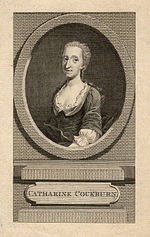

 Date of Birth: 16-Aug-1679
 Place of Birth: London
Date of Death: 11-May-1749
Profession: writer, playwright, philosopher, novelist
Zodiac Sign: Leo 
About Catharine Trotter Cockburn
- Catharine Trotter Cockburn (16 August 1679 – 11 May 1749) was an English novelist, dramatist, and philosopher.
- She wrote on moral philosophy, theological tracts, and had a voluminous correspondence. Trotter's work addresses a range of issues including necessity, the infinitude of space, and the substance, but she focuses on moral issues.
- She thought that moral principles are not innate, but discoverable by each individual through the use of the faculty of reason endowed by God.
- In 1702, she published her first major philosophical work, A Defence of Mr.
- Lock's [sic.] An Essay Concerning Human Understanding.
- John Locke was so pleased with this defence that he made gifts of money and books to his young apologist acting through Elizabeth Burnet who had first made Locke aware of Trotter's "Defence".Her work attracted the attention of William Warburton, who prefaced her last philosophical work.
- She also had a request from the biographer Thomas Birch to aid him in compiling a collection of her works.
- She agreed to the project but died before the work could be printed.
- Birch posthumously published a two-volume collection entitled The Works of Mrs.
- Catharine Cockburn, Theological, Moral, Dramatic, and Poetical in 1751.
- It is largely through this text that readers and history have come to know her.
Read more at Wikipedia
See Also
- Famous People's Birthdays on 16 August, Worldwide
- Famous People's Birthdays in August, Worldwide
- Famous writer's Birthdays on 16 August, Worldwide
- Famous writer's Birthdays in August, Worldwide
- Famous playwright's Birthdays on 16 August, Worldwide
- Famous playwright's Birthdays in August, Worldwide
- Famous philosopher's Birthdays on 16 August, Worldwide
- Famous philosopher's Birthdays in August, Worldwide
- Famous novelist's Birthdays on 16 August, Worldwide
- Famous novelist's Birthdays in August, Worldwide
Image Author, Source and License
Author:
Source:
License: CC-PD-Mark
PD-Art (PD-old-100)
More Details
Unknown
Source:
National Portrait Gallery: NPG D2092

|
While Commons policy accepts the use of this media, one or more third parties have made copyright claims against Wikimedia Commons in relation to the work from which this is sourced or a purely mechanical reproduction thereof. This may be due to recognition of the "sweat of the brow" doctrine, allowing works to be eligible for protection through skill and labour, and not purely by originality as is the case in the United States (where this website is hosted). These claims may or may not be valid in all jurisdictions.
As such, use of this image in the jurisdiction of the claimant or other countries may be regarded as copyright infringement. Please see Commons:When to use the PD-Art tag for more information. See User:Dcoetzee/NPG legal threat for original threat and National Portrait Gallery and Wikimedia Foundation copyright dispute for more information. This tag does not indicate the copyright status of the attached work. A normal copyright tag is still required. See Commons:Licensing. |
License: CC-PD-Mark
PD-Art (PD-old-100)
More Details