Robert Watson-Watt, Date of Birth, Place of Birth, Date of Death
TweetRobert Watson-Watt
physicist
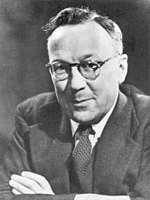

 Date of Birth: 13-Apr-1892
 Place of Birth: Brechin, Scotland, United Kingdom
Date of Death: 05-Dec-1973
Profession: engineer, physicist, inventor, university teacher
Nationality: United Kingdom
Zodiac Sign: Aries 
About Robert Watson-Watt
- Sir Robert Alexander Watson-Watt, KCB, FRS, FRAeS (13 April 1892 – 5 December 1973) was a British pioneer of radio direction finding and radar technology.Watt began his career in radio physics with a job at the Met Office, where he began looking for accurate ways to track thunderstorms using the radio signals given off by lightning.
- This led to the 1920s development of a system later known as huff-duff.
- Although well publicized at the time, the system's enormous military potential was not developed until the late 1930s.
- Huff-duff allowed operators to determine the location of an enemy radio in seconds and it became a major part of the network of systems that helped defeat the U-boat threat.
- It is estimated that huff-duff was used in about a quarter of all attacks on U-boats. In 1935 Watt was asked to comment on reports of a German death ray based on radio.
- Watt and his assistant Arnold Frederic Wilkins quickly determined it was not possible, but Wilkins suggested using radio signals to locate aircraft at long distances.
- This led to a February 1935 demonstration where signals from a BBC short-wave transmitter were bounced off a Handley Page Heyford aircraft.
- Watt led the development of a practical version of this device, which entered service in 1938 under the code name Chain Home.
- This system provided the vital advance information that helped the Royal Air Force win the Battle of Britain.After the success of his invention, Watson-Watt was sent to the US in 1941 to advise on air defence after Japan’s attack on Pearl Harbor.
- He returned and continued to lead radar development for the War Office and Ministry of Supply.
- He was elected a Fellow of the Royal Society in 1941, was given a knighthood in 1942 and was awarded the US Medal for Merit in 1946.
Read more at Wikipedia
See Also
- Famous People's Birthdays on 13 April, United Kingdom
- Famous People's Birthdays in April, United Kingdom
- Famous engineer's Birthdays on 13 April, United Kingdom
- Famous engineer's Birthdays in April, United Kingdom
- Famous physicist's Birthdays on 13 April, United Kingdom
- Famous physicist's Birthdays in April, United Kingdom
- Famous inventor's Birthdays on 13 April, United Kingdom
- Famous inventor's Birthdays in April, United Kingdom
- Famous university teacher's Birthdays on 13 April, United Kingdom
- Famous university teacher's Birthdays in April, United Kingdom