Jesse Washington, Date of Birth, Date of Death
TweetJesse Washington
American lynching victim

 Date of Birth: 01-Jan-1899
Date of Death: 15-May-1916
Nationality: United States
Zodiac Sign: Capricorn 
About Jesse Washington
- Jesse Washington was a black seventeen year old farmhand who was lynched in the county seat of Waco, Texas, on May 15, 1916, in what became a well-known example of racially motivated lynching.
- Washington was convicted of raping and murdering Lucy Fryer, the wife of his white employer in rural Robinson, Texas.
- He was chained by his neck and dragged out of the county court by observers.
- He was then paraded through the street, all while being stabbed and beaten, before being held down and castrated.
- He was then lynched in front of Waco's city hall. Over 10,000 spectators, including city officials and police, gathered to watch the attack.
- There was a celebratory atmosphere among whites at the spectacle murder, and many children attended during their lunch hour.
- Members of the mob cut off his fingers, and hung him over a bonfire after saturating him with coal oil.
- He was repeatedly lowered and raised over the fire for about two hours.
- After the fire was extinguished, his charred torso was dragged through the town and parts of his body were sold as souvenirs.
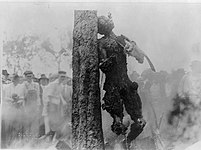
- A professional photographer took pictures as the event unfolded, providing rare imagery of a lynching in progress.
- The pictures were printed and sold as postcards in Waco. Although the lynching was supported by many Waco residents, it was condemned by newspapers around the United States.
- The National Association for the Advancement of Colored People (NAACP) hired Elisabeth Freeman to investigate; she conducted a detailed probe in Waco, despite the reluctance of many residents to speak about the event.
- Freeman concluded that white residents were generally supportive of Washington's lynching.
- She also concluded that Washington killed Fryer.
- After receiving Freeman's report on the lynching, NAACP co-founder and editor W.
- E.
- B.
- Du Bois published an in-depth report featuring photographs of Washington's charred body in The Crisis, and the NAACP featured his death in their anti-lynching campaign.
- Historians have noted that Washington's death helped alter the way lynching was viewed.
- The widespread negative publicity helped curb public support for the practice.
- In the 1990s and 2000s, some Waco residents lobbied for a monument to Washington's lynching, but this idea failed to garner wide support in the city.
- On the centenary of the event, in May 2016, the mayor of Waco held a formal ceremony to apologize to Washington's descendants and the African-American community.
- A historical marker has been installed to memorialize the lynching.
Read more at Wikipedia