Janusz Głuchowski, Date of Birth, Place of Birth, Date of Death
TweetJanusz Głuchowski
Polish general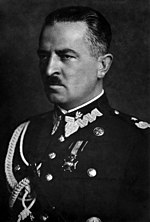

 Date of Birth:
  Place of Birth: Bukowa, Łódź Voivodeship, Łódź Voivodeship, Poland
About Janusz Głuchowski
- Janusz Julian Gluchowski (nom de guerre Janusz) was a divisional general of the Polish Army in the Second Polish Republic.
- Born on August 6, 1888 in Bukowa (Congress Poland), he fought in Polish Legions in World War I, Polish–Ukrainian War, Polish–Soviet War and the Invasion of Poland.
- Gluchowski died on June 11, 1964 in London. As a teenager, Gluchowski attended a high school in Czestochowa, where he joined a secret Polish organization and took part in a school strike action.
- In 1905, he became a member of Combat Organization of the Polish Socialist Party, and was wounded in one hand during a raid near Czestochowa.
- To avoid arrest by Russian authorities, Gluchowski left for Belgium, where he studied at the University of Liege.
- In 1909, he founded Belgian branch of Union of Active Struggle. Gluchowski returned to partitioned Poland in ca.
- 1910, and settled in Austrian Galicia.
- In 1912, he graduated from officer school of the Riflemen's Association in Stroza near Kraków.
- In August 1914, he commanded a platoon in Oleandry, and was deputy of Wladyslaw Belina-Prazmowski during the legendary raid of the so-called Seven Lancers of Belina.
- On August 6, together with First Cadre Company, Gluchowski left Kraków and marched to Miechow. In October 1914 he was promoted to lieutenant (Poruchik), and in November 1916 to Rittmeister.
- Until 1917, he served in 1st Polish Legions Uhlan Regiment, and was its last commandant.
- After the Oath crisis, Gluchowski was interned first in Fort Beniaminow, later in Werl. Released in October 1918, Gluchowski came to Lublin, where in early November he formed 3rd Uhlan Regiment (later renamed into 7th Lublin Uhlan Regiment).
- Together with his unit, Gluchowski fought in the Polish–Soviet War.
- On May 29, 1920, he was promoted to Polkovnik.
- In July 1920, Gluchowski was transferred to Eastern Galicia, where he took command of 1st Cavalry Brigade, and fought against the Soviets in both Galicia and Volhynia. After the war, he remained in his post until 1925, when he was transferred to 4th Cavalry Brigade.
- On March 16, 1927, Gluchowski was promoted to General brygady.
- On June 4, 1930, he was appointed commandant of Center of Higher Military Studies, and three years later, after death of General Stanislaw Tessaro, he was named commandant of Military District X in Przemysl.
- In October 1935, he became deputy Minister of Military Affairs. In the early days of the Invasion of Poland, Gluchowski ordered General Walerian Czuma to prepare the defence of Warsaw.
- In mid-September 1939 he fled to Romania, and was interned in a camp.
- After the escape, Gluchowski managed to travel to the Middle East, and in January 1941 he was ordered to come to London.
- In October 1941 he was appointed commandant of Training Brigade, stationed in Scotland.
- On September 23, 1943, Gluchowski was named commandant of all units of the Polish Army stationed in Great Britain, except for the 1st Independent Parachute Brigade, which remained under authority of Commander in Chief.
- On June 1, 1945, Gluchowski was promoted to divisional general. In 1945, Gluchowski decided not to return to Soviet-occupied Poland, and remained in Great Britain.
- He frequently criticized Soviet regime and Soviet occupational authorities in postwar Poland.
- Furthermore, he was one of founders and chairman of Jozef Pilsudski Institute in London.
- Gluchowski was an active member of Polish community of Great Britain: he was chairman and honorary member of several organizations of Polish veterans.
- He died on June 11, 1964 in London.
Read more at Wikipedia
Image Author, Source and License
Author: Unknown
Source:
License: PD Polish
More Details
Source:
Krzysztof Gluchowski - collection of the late gen.Janusz Gluchowski

|
This photograph is in the public domain because according to the Art. 3 of copyright law of March 29, 1926 of the Republic of Poland and Art. 2 of copyright law of July 10, 1952 of the People's Republic of Poland, all photographs by Polish photographers (or published for the first time in Poland or simultaneously in Poland and abroad) published without a clear copyright notice before the law was changed on May 23, 1994 are assumed to be in the public domain in Poland.
This work is in the public domain in the United States because it meets three requirements:
|
 |

|
This image (or other media file) is in the public domain because its copyright has expired and its author is anonymous.
This applies to the European Union and those countries with a copyright term of 70 years after the work was made available to the public and the author never disclosed their identity. Important: Always mention where the image comes from, as far as possible, and make sure the author never claimed authorship. |
 |
 |
Note: In Germany and possibly other countries, certain anonymous works published before July 1, 1995 are copyrighted until 70 years after the death of the author. See Übergangsrecht. Please use this template only if the author never claimed authorship or his/her authorship never became public in any other way. If the work is anonymous or pseudonymous (e.g., published only under a corporate or organization's name), use this template for images published more than 70 years ago.
For a work made available to the public in the United Kingdom, please use Template:PD-UK-unknown instead.
|
License: PD Polish
More Details