Eduard Mandel, Date of Birth, Place of Birth, Date of Death
TweetEduard Mandel
German engraver
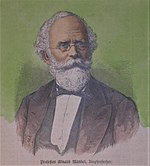

 Date of Birth: 15-Feb-1810
 Place of Birth: Berlin
Date of Death: 20-Oct-1882
Profession: copperplate engraver
Nationality: German Empire
Zodiac Sign: Aquarius 
About Eduard Mandel
- Johann August Eduard Mandel (1810-1882) was a German engraver. He was born at Berlin in 1810, and early received encouragement from King Frederick William III.
- He entered the academy in 1826, and worked under Professor Buchhorn.
- Inconsequence of the success of his first work,' The Warrior and his Daughter,' after Hildebrand, in 1830, he was appointed by the academy to engrave the 'Loreley' after Regass.
- In the same year he obtained a third class medal at Paris, and in 1844 a second class.
- In 1855 he sent to the Paris Universal Exhibition, 'Christ weeping over Jerusalem,' after Ary Schefier, the 'Portrait of Frederick William TV.
- after Otto; 'Two Children,' after Magnus, and his famous 'Portrait of Charles I,' after Vandyke; and was rewarded with a medal of the first class.
- He was appointed professor of engraving in 1842. Mandel was born in Berlin.
- He studied from 1824 with the map engraver Johann Karl Mare, and from 1826 to 1830 in the studio of Ludwig Buchhorn.
- His first engraving was a portrait of Friedrich Wilhelm III after his own design (1830).
- He completed his first larger work in 1835, Der Krieger und sein Kind, after a painting by Theodor Hildebrandt; it was so well received that he was assigned by the Prussian Art Association to make an engraving after Lurlei by Carl Joseph Begas (completed 1839).
- In 1837, he was appointed a member of the Akademie der Künste.
- In 1840 he traveled to Paris, to study further with Louis Pierre Henriquel-Dupont and Auguste Gaspard Louis Desnoyers, among others.
- While there, he produced the engraving Italienischen Hirtenknaben after a painting by Pollack.
- After his return he produced a series of engravings considered among the finest in 19th-century German engraving.
- He was head of the engraving studio at the Akademie der Künste from 1856.
- His most important work, done shortly before his death, was an engraving after the Sistine Madonna of Raphael.
Read more at Wikipedia