Marquis de Sade, Date of Birth, Place of Birth, Date of Death
TweetMarquis de Sade
novelist and philosopher streamer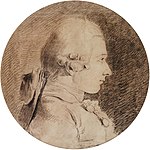

 Date of Birth:
  Place of Birth: Paris, Île-de-France, France
About Marquis de Sade
- Donatien Alphonse François, Marquis de Sade (French: [d?nasj?~ alf?~z f??~swa, ma?ki d? sad]; 2 June 1740 – 2 December 1814), was a French nobleman, revolutionary politician, philosopher and writer, famous for his libertine sexuality.
- His works include novels, short stories, plays, dialogues, and political tracts.
- In his lifetime some of these were published under his own name while others, which Sade denied having written, appeared anonymously.
- Sade is best known for his erotic works, which combined philosophical discourse with pornography, depicting sexual fantasies with an emphasis on violence (particularly against women and children), suffering, criminality and blasphemy against Christianity.
- He became infamous for numerous rapes and sexual abuse of young men, women and children.
- He claimed to be a proponent of absolute freedom, unrestrained by morality, religion or law.
- The words sadism and sadist are derived from his name.Sade was incarcerated in various prisons and an insane asylum for about 32 years of his life: 11 years in Paris (10 of which were spent in the Bastille), a month in the Conciergerie, two years in a fortress, a year in Madelonnettes Convent, three years in Bicêtre Asylum, a year in Sainte-Pélagie Prison, and 12 years in the Charenton Asylum.
- During the French Revolution, he was an elected delegate to the National Convention.
- Many of his works were written in prison. There continues to be a fascination with Sade among scholars and in popular culture.
- Prolific French intellectuals such as Roland Barthes, Jacques Lacan, Jacques Derrida and Michel Foucault published studies of him.
- On the other hand the French hedonist philosopher Michel Onfray has attacked this cult, writing that "It is intellectually bizarre to make Sade a hero." There have also been numerous film adaptions of his work, the most notable being Salò, or the 120 Days of Sodom, an adaptation of his infamous book, The 120 Days of Sodom.
Read more at Wikipedia
See Also
- Famous People's Birthdays on 02 June, France
- Famous People's Birthdays in June, France
- Famous writer's Birthdays on 02 June, France
- Famous writer's Birthdays in June, France
- Famous playwright's Birthdays on 02 June, France
- Famous playwright's Birthdays in June, France
- Famous philosopher's Birthdays on 02 June, France
- Famous philosopher's Birthdays in June, France
- Famous novelist's Birthdays on 02 June, France
- Famous novelist's Birthdays in June, France
Image Author, Source and License
Author:
Source: http://en.wikipedia.org/wiki/Image:Marquis_de_sade.jpg
License: CC-PD-Mark
PD-Art (PD-old-100)
More Details
Charles-Amédée-Philippe van Loo
(1719–1795)   |
|||
|---|---|---|---|
 |
|||
| Description | French painter | ||
| Date of birth/death | 25 August 1719 | 15 November 1795 | |
| Location of birth/death | Rivoli | Paris | |
| Authority control | |||
Source: http://en.wikipedia.org/wiki/Image:Marquis_de_sade.jpg
License: CC-PD-Mark
PD-Art (PD-old-100)
More Details