
 Date of Birth:
  Place of Birth: Tirana, Tirana County, Albania
About Aleksandër Meksi
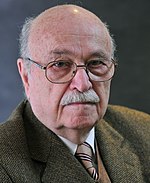
- Aleksandër Meksi (8 March 1939, Tirana) is a researcher and restorer of monuments of medieval architecture (mainly churches and mosques) and politician.
- His father was Gabriel Meksi (Labovë 1894-1958), a history teacher, and his mother Efigjeni Haxhistasa (Berat 1912-1983).
- He is married to Dhurata Shala and has two sons, Endri and Redon. He completed undergraduate studies in the construction branch at the Faculty of Engineering of the State University of Tirana (1955-1960).
- Until the end of 1990 he worked mainly at the Institute of Monuments of Culture.
- In 1965 he completed specialization (6 months) at the “Scuola di perfezionamento per lo studio e il restauro dei monumenti” at the faculty of architecture of the University of Rome.
- During the academic years 1974 -1977 he taught the subject of Architecture History in the construction branch at the Faculty of Engineering of the State University of Tirana.
- While in the academic year 1989-1990 he was a lecturer for two subjects (exercises and seminars-in the first semester) at the University of Marburg.
- The research activity and the tracking and restoration of monuments is reflected in dozens of articles and monographs as single author or co-author.
- Holds the titles Candidate of Science (1982) and Doctor of Science (1988) and Professor (1995). Political career begins in December 1990 as co-founder and drafter of the Minimal Program, of the Statute of the Democratic Party and member of its Initiative Commission.
- Since then, until 1997, he has been member of DP' Presidency, as well as ex oficio member of National Council (except 1997-2001).
- Since the first pluralistic elections, he has been elected deputy in the Albanian Parliament (1991-2001).
- Following the victory of the Democratic Party on 22 March 1992, on April 13, he was elected Prime Minister of the Democratic Government, a post he held until 13 March 1997 (after resigning on March 1).
- That Government undertook the reform of the Albanian state, from a state of the dictatorship of the proletariat in a democratic state of law, with a free market economy, where human rights are respected.
- Tough duty for a country in a complete political-economic and social crisis, in a country plagued by communist insanity and the proletariat's dictatorship.
- With the help of the countries of United Europe and the U.S.A the communist state was overthrown, a new state was created with new Codes and laws, with radical changes in the political and economic system that transformed Albania in those years.
- Since 2001 has held a critical approach to the leaders of the Democratic Party for the lack of internal democracy and bad governance during the years 2005-2013; but continues to be active in the political life of the country with political writings as opposition, interviews and conversations on media.
Read more at Wikipedia