William R. Poage, Date of Birth, Place of Birth, Date of Death
TweetWilliam R. Poage
Texas politician
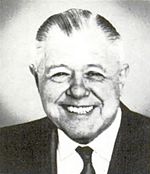

 Date of Birth: 28-Dec-1899
 Place of Birth: Waco, Texas, United States
Date of Death: 03-Jan-1987
Profession: lawyer, politician, farmer, university teacher
Nationality: United States
Zodiac Sign: Capricorn 
About William R. Poage
- William Robert Poage (December 28, 1899 – January 3, 1987) was a Texas politician. Poage was born in Waco, Texas and was raised near Woodson.
- He attended the schools of Throckmorton County, and during World War I served as an apprentice seaman in the United States Navy.
- He attended the University of Texas at Austin and the University of Colorado Boulder before receiving a Bachelor of Arts degree from Baylor University in 1921.
- He farmed and taught geology at Baylor before attending Baylor Law School, from which he received his LL.B.
- in 1924.
- Poage practiced law in Waco and taught at Baylor Law.
- A Democrat, he served in the Texas House of Representatives from 1925 to 1929, and the Texas State Senate from 1931 to 1937. In 1936, Poage was elected to the House of Representatives.
- He was later diagnosed with Ménière's disease, which eventually left him deaf in one ear.
- In the House, he supported acts designed to help the rural residents of his district.
- He supported the farm price supports of the Roosevelt Administration, and worked to keep farmers prosperous.
- Poage was the chairman of the Committee on Agriculture from 1967 to 1975, until he was removed from his position in a revolt by House Democratic Caucus against the Seniority system.
- The Caucus considered Poage to be too conservative and he was replaced by Tom Foley. He was one of the majority of the Texan delegation to decline to sign the 1956 Southern Manifesto opposing the desegregation of public schools ordered by the Supreme Court in Brown v.
- Board of Education. Poage did not run for re-election in 1978 and retired to his home in Waco, Texas.
- The following year the W.
- R.
- Poage Legislative Library for Graduate Studies and Research was dedicated on the Baylor University Campus to house Poage's congressional papers and the papers of eight other former U.
- S.
- Congressmen.
- On January 3, 1987, he died of heart failure at 87 years old after receiving open heart surgery.
Read more at Wikipedia
See Also
- Famous People's Birthdays on 28 December, United States
- Famous People's Birthdays in December, United States
- Famous lawyer's Birthdays on 28 December, United States
- Famous lawyer's Birthdays in December, United States
- Famous politician's Birthdays on 28 December, United States
- Famous politician's Birthdays in December, United States
- Famous farmer's Birthdays on 28 December, United States
- Famous farmer's Birthdays in December, United States
- Famous university teacher's Birthdays on 28 December, United States
- Famous university teacher's Birthdays in December, United States