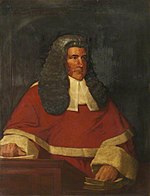

 Date of Birth:
About William Wightman (judge)
- Sir William Wightman (28 September 1784 – 10 December 1863) was a British judge. Wightman came of an old Dumfriesshire family, the son of William Wightman, gentleman, of St.
- Clement's, London, and his wife, Elisabeth.
- He was baptised at St Clement Danes at nearly 1 year old.
- He was an undergraduate of University College, Oxford, where he matriculated on 23 March 1801, and on 21 June was elected to a Michel exhibition at Queen's College, graduating BA on 30 May 1805, and MA on 23 October 1809; from 1859 to 1863 he was an honorary fellow of his college. On 31 January 1804, he entered Lincoln's Inn, and, after some years of practice as a special pleader, he was called to the bar in 1821.
- In 1830 he transferred himself to the Inner Temple and joined the Northern Circuit.
- He was known as an exceptionally sound and clear-headed lawyer, and for several years held the important post of junior counsel to the treasury.
- He was appointed a member of the commission of 1830 upon the practice of the common law courts, and of that of 1833 upon the proposal for a criminal law digest.
- He was engaged in many celebrated cases, particularly the prosecutions arising out of the Bristol riots; but, owing to an almost excessive modesty, was little known except to his profession.
- In February 1841 he was promoted to a judgeship of the Queen's Bench, on the resignation of Mr.
- Justice Littledale, and was knighted on 28 April, and here he served as a judge for nearly twenty-three years.
- While on circuit at York, on 9 December 1863, he was seized with an attack of apoplexy, and died next day.
- He married in 1819, a daughter of James Baird of Lasswade, near Edinburgh. Wightman's preeminent qualities as a lawyer were accuracy and caution.
- As a judge he had deep learning, a faculty of lucid reasoning, and abundance of good sense.
- He was courteous, firm, and dignified, and added greatly to the strength of the court of which he was a member.
- He had also great humour, considerable literary gifts, and was widely read in English letters.
Read more at Wikipedia