Francis Galton, Date of Birth, Place of Birth, Date of Death
TweetFrancis Galton
English polymath: geographer, statistician, pioneer in eugenics
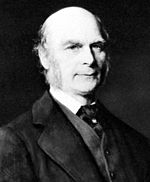

 Date of Birth: 16-Feb-1822
 Place of Birth: Birmingham, England, United Kingdom
Date of Death: 17-Jan-1912
Profession: photographer, writer, mathematician, inventor, psychologist, geographer, sociologist, meteorologist, statistician, geneticist, anthropologist, philosopher, explorer
Zodiac Sign: Aquarius 
About Francis Galton
- Sir Francis Galton, FRS (; 16 February 1822 – 17 January 1911) was an English Victorian era statistician, polymath, sociologist, psychologist, anthropologist, eugenicist, tropical explorer, geographer, inventor, meteorologist, proto-geneticist, and psychometrician.
- He was knighted in 1909. Galton produced over 340 papers and books.
- He also created the statistical concept of correlation and widely promoted regression toward the mean.
- He was the first to apply statistical methods to the study of human differences and inheritance of intelligence, and introduced the use of questionnaires and surveys for collecting data on human communities, which he needed for genealogical and biographical works and for his anthropometric studies. He was a pioneer in eugenics, coining the term itself.[This book's] intention is to touch on various topics more or less connected with that of the cultivation of race, or, as we might call it, with "eugenic"1 questions, and to present the results of several of my own separate investigations.1 This is, with questions bearing on what is termed in Greek, eugenes, namely, good in stock, hereditarily endowed with noble qualities.
- This, and the allied words, eugeneia, etc., are equally applicable to men, brutes, and plants.
- We greatly want a brief word to express the science of improving stock, which is by no means confined to questions of judicious mating, but which, especially in the case of man, takes cognisance of all influences that tend in however remote a degree to give the more suitable races or strains of blood a better chance of prevailing speedily over the less suitable than they otherwise would have had.
- The word eugenics would sufficiently express the idea; it is at least a neater word and a more generalised one than viriculture, which I once ventured to use. He also coined the phrase "nature versus nurture".
- His book Hereditary Genius (1869) was the first social scientific attempt to study genius and greatness.As an investigator of the human mind, he founded psychometrics (the science of measuring mental faculties) and differential psychology and the lexical hypothesis of personality.
- He devised a method for classifying fingerprints that proved useful in forensic science.
- He also conducted research on the power of prayer, concluding it had none by its null effects on the longevity of those prayed for.
- His quest for the scientific principles of diverse phenomena extended even to the optimal method for making tea.As the initiator of scientific meteorology, he devised the first weather map, proposed a theory of anticyclones, and was the first to establish a complete record of short-term climatic phenomena on a European scale.
- He also invented the Galton Whistle for testing differential hearing ability.
- He was Charles Darwin's half-cousin.
Read more at Wikipedia
See Also
- Famous People's Birthdays on 16 February, United Kingdom
- Famous People's Birthdays in February, United Kingdom
- Famous photographer's Birthdays on 16 February, United Kingdom
- Famous photographer's Birthdays in February, United Kingdom
- Famous writer's Birthdays on 16 February, United Kingdom
- Famous writer's Birthdays in February, United Kingdom
- Famous mathematician's Birthdays on 16 February, United Kingdom
- Famous mathematician's Birthdays in February, United Kingdom
- Famous inventor's Birthdays on 16 February, United Kingdom
- Famous inventor's Birthdays in February, United Kingdom
- Famous psychologist's Birthdays on 16 February, United Kingdom
- Famous psychologist's Birthdays in February, United Kingdom
- Famous geographer's Birthdays on 16 February, United Kingdom
- Famous geographer's Birthdays in February, United Kingdom
- Famous sociologist's Birthdays on 16 February, United Kingdom
- Famous sociologist's Birthdays in February, United Kingdom
- Famous meteorologist's Birthdays on 16 February, United Kingdom
- Famous meteorologist's Birthdays in February, United Kingdom