Catherine Parr, Date of Birth, Place of Birth, Date of Death
TweetCatherine Parr
Queen Consort of Henry VIII
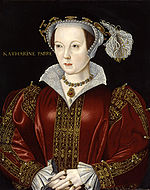

 Date of Birth: 01-Jan-0001
 Place of Birth: Kendal, England, United Kingdom
Date of Death: 07-Sep-1548
Profession: writer, lady-in-waiting
Zodiac Sign: Capricorn 
About Catherine Parr
- Catherine Parr (sometimes alternatively spelled Katherine, Katheryn, Kateryn or Katharine) (1512 – 5 September 1548) was queen consort of England and Ireland (1543–47) as the last of the six wives of King Henry VIII, and the final queen consort of the House of Tudor.
- She married him on 12 July 1543, and outlived him by one year.
- With four husbands she is the most-married English queen. Catherine enjoyed a close relationship with Henry's three children and was personally involved in the education of Elizabeth I and Edward VI.
- She was influential in Henry's passing of the Third Succession Act in 1543 that restored both his daughters, Mary and Elizabeth, to the line of succession to the throne.Catherine was appointed regent from July to September 1544 while Henry was on a military campaign in France and in case he lost his life, she was to rule as regent until Edward came of age.
- However he did not give her any function in government in his will.
- In 1543, she published her first book, Psalms or Prayers, anonymously.
- On account of Catherine's Protestant sympathies, she provoked the enmity of anti-Protestant officials, who sought to turn the King against her; a warrant for her arrest was drawn up in 1545.
- However, she and the King soon reconciled.
- Her book Prayers or Meditations became the first book published by an English queen under her own name.
- She assumed the role of Elizabeth's guardian following the King's death, and published a second book, The Lamentation of a Sinner. Henry died on 28 January 1547.
- After the king's death, Catherine was allowed to keep the queen's jewels and dresses as queen dowager.
- About six months after Henry's death, she married her fourth and final husband, Thomas Seymour, 1st Baron Seymour of Sudeley.
- The marriage was short-lived, as she died on Wednesday, 5 September 1548 due to complications of childbirth.
- Parr's funeral was held on 7 September 1548.
- Parr's funeral was the first Protestant funeral held in English in England, Scotland, and Ireland.
Read more at Wikipedia
See Also
- Famous People's Birthdays on 01 January, United Kingdom
- Famous People's Birthdays in January, United Kingdom
- Famous writer's Birthdays on 01 January, United Kingdom
- Famous writer's Birthdays in January, United Kingdom
- Famous lady-in-waiting's Birthdays on 01 January, United Kingdom
- Famous lady-in-waiting's Birthdays in January, United Kingdom
Image Author, Source and License
Author:
Source:
License: PD US expired
PD-Art (PD UK)
More Details
attributed to William Scrots (see Hayward, Maria: Dress at the Court of King Henry VIII, Maney Publishing, 2007, ISBN 1904350704)
Source:
National Portrait Gallery: NPG 4618

|
While Commons policy accepts the use of this media, one or more third parties have made copyright claims against Wikimedia Commons in relation to the work from which this is sourced or a purely mechanical reproduction thereof. This may be due to recognition of the "sweat of the brow" doctrine, allowing works to be eligible for protection through skill and labour, and not purely by originality as is the case in the United States (where this website is hosted). These claims may or may not be valid in all jurisdictions.
As such, use of this image in the jurisdiction of the claimant or other countries may be regarded as copyright infringement. Please see Commons:When to use the PD-Art tag for more information. See User:Dcoetzee/NPG legal threat for original threat and National Portrait Gallery and Wikimedia Foundation copyright dispute for more information. This tag does not indicate the copyright status of the attached work. A normal copyright tag is still required. See Commons:Licensing. |
License: PD US expired
PD-Art (PD UK)
More Details