Vera Gedroits, Date of Birth, Date of Death
TweetVera Gedroits
Russified Lithuanian surgeon, writer and princess
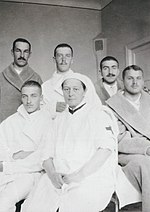

 Date of Birth: 07-Apr-1870
Date of Death: 01-Mar-1932
Profession: writer, physician, poet, physician writer, surgeon
Zodiac Sign: Aries 
About Vera Gedroits
- Princess Vera Ignatievna Gedroits (Russian: ??´?? ????´?????? ?????´??, IPA: ['v??r? ?g'nat?j?vn? g??'drojts] listen ; Ukrainian: ???? ?????????? ????????; 7 April 1870 O.S./19 April 1870 (N.
- S.) – March 1932, literary pen name Sergei Gedroits) was a Russian doctor of medicine and author.
- She was the first female military surgeon in Russia, the first female professor of surgery, and the first woman to serve as a physician in the Imperial Palace of Russia.
- She is remembered as a pioneer in applying laparotomy for the treatment of abdominal wounds on the battlefront.
- Her success with rapid surgical intervention played a part in changing international military medical policy.
- She wrote poetry and prose, although according to Konstantin Fedin her best works were her fictionalized autobiographical stories. Gedroits was born in southwestern Russia into the Giedroyc family of Lithuanian nobility.
- After early tutoring at home, she attended the woman's gymnasium in the Oryol Governorate and then continued her education in St.
- Petersburg.
- Following her involvement in a student movement, she was placed under surveillance at her father's estate.
- Unable to continue her studies in Russia, and despite being openly lesbian, Gedroits entered into a marriage of convenience, which allowed her to obtain a passport in another name and leave the country.
- Arriving in Lausanne, Switzerland, she enrolled in the medical courses of César Roux and graduated in 1898.
- For the next two years she worked as an assistant to Roux, but returned to Russia because of illnesses in her family. Beginning her career as a factory physician, Gedroits organized a modern hospital in the rural area and treated workers, their families and people from the surrounding communities.
- Concerned at the lack of safety measures and knowledge of hygiene, nutrition and sanitation, she conducted research into the medical problems affecting her patients and made recommendations to improve their conditions.
- With the outbreak of the Russo-Japanese War, she organized the Nobles' Mobile Hospital Train and operated on the front lines.
- She performed abdominal surgeries against established medical policy, leading to a change in the way battlefield medicine was performed.
- Much decorated from her war service, she was offered a position at the Tsarskoye Selo Court Hospital and served as physician to the royal court until the outbreak of World War I.
- Training the Tsarina Alexandra and her daughters as nurses, she organized the medical staff and hospital trains in preparation to receive the wounded. When Tsar Nicholas abdicated at the beginning of the Russian Revolution, Gedroits joined the 6th Siberian Rifle Regiment and returned to the battle front.
- Wounded, she was evacuated to Kiev, where she resumed her work as a physician and academic.
- In 1921, she was hired to teach pediatric surgery at the Kiev Medical Institute and within two years was appointed a professor of medicine.
- She produced almost 60 scientific papers before being promoted to head the Institute's surgery department in 1929.
- Soviet purges at that time removed her from office in 1930 and denied her a pension.
- Buying a farm on the outskirts of Kiev, Gedroits turned her attention to writing autobiographical novels until her death from uterine cancer in 1932.
Read more at Wikipedia
See Also
- Famous People's Birthdays on 07 April, Worldwide
- Famous People's Birthdays in April, Worldwide
- Famous writer's Birthdays on 07 April, Worldwide
- Famous writer's Birthdays in April, Worldwide
- Famous physician's Birthdays on 07 April, Worldwide
- Famous physician's Birthdays in April, Worldwide
- Famous poet's Birthdays on 07 April, Worldwide
- Famous poet's Birthdays in April, Worldwide
- Famous physician writer's Birthdays on 07 April, Worldwide
- Famous physician writer's Birthdays in April, Worldwide
- Famous surgeon's Birthdays on 07 April, Worldwide
- Famous surgeon's Birthdays in April, Worldwide