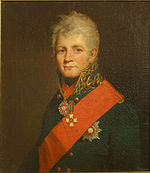

 Date of Birth:
  Place of Birth: Saint Petersburg
About Pavel Chichagov
- Pavel Vasilievich Chichagov or Tchichagov (Russian: ??´??? ????´?????? ????´???) (8 July [O.S.
- 27 June] 1767 – 20 August 1849) was a Russian military and naval commander of the Napoleonic Wars. He was born in 1767 in Saint Petersburg, the son of Admiral Vasili Chichagov and his English wife.
- At the age of 12 he was enlisted in the Guard.
- In 1782 he served in a campaign in the Mediterranean as an aide to his father.
- He served with distinction in the Russian-Swedish War of 1788-1790, where he commanded the Rostislav and was awarded the Order of St.
- George, fourth degree, and a golden sword with the inscription "For Courage". After the war, he studied at the Royal Naval Academy.
- While there, he met Elizabeth Proby, the daughter of a commissioner at the Chatham dockyard, and became engaged to her.
- When he returned to Russia in 1796, he applied for permission to marry but was told by Paul I "there are sufficient brides in Russia; there is no need to look for one in England." Some violence followed and Chichagov was sent to prison.
- He was soon pardoned, given permission to marry Elizabeth, and promoted to Rear Admiral.
- In 1802, Alexander I, Paul's successor, promoted Chichagov to Vice Admiral and made him a member of the Committee on Navy Reorganization.
- In 1807, he was promoted to Admiral and appointed Minister of the Navy. Chichagov resigned and traveled in Europe in 1809-1811.
- Elizabeth died in 1811.
- In 1812, Alexander recalled him and appointed him Commander in Chief of the newly formed Third Western Army and Governor-General of Moldavia and Wallachia.
- However, the 1812 Treaty of Bucharest ended the Russo-Turkish War by the time he took command of the army.
- During the 1812 campaign against Napoleon, he was blamed for letting Napoleon escape at the Berezina River in November 1812.
- In 1813, he was dismissed and the following year went to France on a furlough, never to return to Russia.
- He remained a member of the State Council until 1834 but was then removed from that position, and his properties confiscated.
- He died in Paris in 1849 where after his death his memoirs were published.
Read more at Wikipedia