Vincas Vitkauskas, Date of Birth, Place of Birth, Date of Death
TweetVincas Vitkauskas
politician
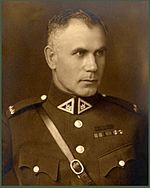

 Date of Birth: 04-Oct-1890
 Place of Birth: Suwałki Governorate, Congress Poland
Date of Death: 03-Mar-1965
Profession: politician
Zodiac Sign: Libra 
About Vincas Vitkauskas
- Vincas Vitkauskas (4 October 1890 – 3 March 1965) was a Lithuanian general.
- He became commander of the Lithuanian Army after the resignation of Stasys Raštikis in January 1940.
- In this capacity, Vitkauskas opposed armed resistance to the Soviet occupation in June 1940 and subsequently collaborated with the new Soviet regime. During World War I, he was mobilized to the Imperial Russian Army and served in the Romanian Front where he became close friends with Antanas Merkys.
- This relationship proved crucial in Vitkauskas' career.
- He returned to Lithuania in 1918 and fought in the Lithuanian Wars of Independence.
- Thanks to Merkys, Vitkauskas became deputy commander of the Lithuanian Military Brigade and commandant of Klaipeda in the aftermath of the Klaipeda Revolt.
- Despite success in the field and evaluation as a capable officer, his military career was dampened by rumors and suspicions that he sympathized with the Bolsheviks and socialists.
- He resigned active duty in 1927 and worked as a lecturer at the higher military courses in Kaunas.
- After the completion of training with the German Reichswehr in 1929, Vitkauskas became inspector of the infantry and helped Stasys Raštikis, commander of the army, to implement much needed reforms.
- He was particularly involved with practical training and military exercises.
- In October 1939, Vitkauskas led Lithuanian troops to Vilnius – the historical capital of the Grand Duchy of Lithuania which was fiercely contested between Lithuania and Poland since 1920.
- It was a prominent assignment that brought public recognition. In November 1939, Merkys became Prime Minister.
- Raštikis resigned in January 1940 and was replaced by Vitkauskas.
- When Soviet Union presented an ultimatum on 14 June, Vitkauskas argued against armed resistance.
- The ultimatum was accepted and Lithuania lost its independence.
- Vitkauskas collaborated with the new regime becoming Minister of Defense in the People's Government, an elected delegate of the People's Seimas, and a member of the delegation that presented Joseph Stalin with a Lithuanian petition to become one of the republics of the Soviet Union.
- The Lithuanian Army was reorganized into the 29th Rifle Corps of the Red Army commanded by Vitkauskas.
- In June 1941, just before the German invasion of Russia, Vitkauskas was sent to the Military Academy of the General Staff in Moscow where he studied and later taught until early 1946.
- He returned to Lithuania and taught at the University of Kaunas and Kaunas Polytechnic Institute until retirement in 1954.
Read more at Wikipedia