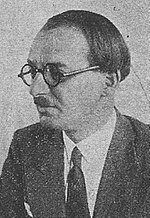

 Date of Birth:
About Emil Dorian
- Emil Dorian (born Emil Lustig; February 16, 1893–1956) was a Romanian poet and prose writer, as well as a physician. Born into a Jewish family in Bucharest, his parents were Herman Lustig and his wife Ernestina (née Picher).
- He attended high school in his native city, followed by the medical faculty of Bucharest University.
- Although, as a Jew, he was not yet a Romanian citizen, he was sent to the front in World War I as a physician.
- After the war, he spent two years in France for medical specialization.
- He then worked as a doctor in Bucharest, and was also active within the Jewish community, for instance editing the 1946 Raportul general asupra situa?iei comunita?ii.
- A significant part of his journalistic work is signed with the pen names Dr.
- Knox, Dr.
- Otorin, Dr.
- M.
- Prunk and Dr.
- Urzica; publications in which he appeared include Cotidianul, Ziua, Adevarul literar ?i artistic, Adam, Gândirea, Nazuin?a, Omul liber, Puntea de filde?, Sburatorul and ?antier.His first verses, signed Castor ?i Pollux, appeared in Noua Revista Româna in 1912; his first book was the poetry collection Cântece pentru Lelioara (1923), followed by În pragul serii (1924).
- The poems in his Primavara noua (1948) and Steagurile inimii (1949), written early in the communist regime, are in socialist realist style; he subsequently wrote one other poetry book, for children Buna diminea?a (1953).
- His novels dealt with social problems drawn from the local Jewish environment: Profe?i ?i paia?e (1931), Vagabonzii (1935) and Otrava (1947).
- He also wrote books that popularized and vulgarized medicine: Misterele ?i tehnica sexualita?ii, 1932; Adevarurile sexualita?ii, 1932; Femei ?i doctori, 1932.
- He put together a collection of texts on the history of medicine (Din trecutul nostru ?tiin?ific, 1955) and wrote a social observation novel set in the insect world (Memoriile greierului, 1937).
- Authors he translated include Heinrich Heine, Edmond Haraucourt and Hanns Heinz Ewers.
- He kept a diary from 1937 onwards, recounting both his struggles as a writer and the increase in far-right activity around him.
- The World War II-era Ion Antonescu regime officially banned his entire work as "Jewish".
- He developed an interest in Yiddish poetry in the mid-1930s, translating and collecting over 400 poems; these were ready for publication in 1944 but were not published until 1996.
Read more at Wikipedia
See Also
- Famous People's Birthdays on 16 February, Romania
- Famous People's Birthdays in February, Romania
- Famous physician's Birthdays on 16 February, Romania
- Famous physician's Birthdays in February, Romania
- Famous poet's Birthdays on 16 February, Romania
- Famous poet's Birthdays in February, Romania
- Famous translator's Birthdays on 16 February, Romania
- Famous translator's Birthdays in February, Romania
- Famous children's writer's Birthdays on 16 February, Romania
- Famous children's writer's Birthdays in February, Romania
- Famous diarist's Birthdays on 16 February, Romania
- Famous diarist's Birthdays in February, Romania