Jean-Hilaire Aubame, Date of Birth, Place of Birth, Date of Death
TweetJean-Hilaire Aubame
Gabonese politician
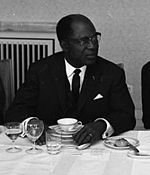

 Date of Birth: 10-Nov-1912
 Place of Birth: Libreville, Estuaire Province, Gabon
Date of Death: 16-Aug-1989
Profession: politician, diplomat
Nationality: France, Gabon
Zodiac Sign: Scorpio 
About Jean-Hilaire Aubame
- Jean-Hilaire Aubame (10 November 1912 – 16 August 1989) was a Gabonese politician active during both the colonial and independence periods.
- The French journalist Pierre Péan said that Aubame's training "as a practicing Catholic and a customs official helped to make him an integrated man, one of whom political power was not an end in itself."Born into a Fang family, Aubame was orphaned at a young age.
- He was raised by the stepbrother of Léon M'ba, who became Aubame's chief political rival.
- Encouraged by his colleagues, Aubame entered politics, serving as Gabon's first representative in the National Assembly of France from 1946 to 1958.
- Aubame was also a leader in solving African problems, particularly developing the Gabonese standard of living and planning urban sites.
- Aubame's quick rise in Gabonese politics was spurred by the support of the missions and administration, whereas much of M'ba's strength came from the colonists. Despite a rivalry, Aubame and M'ba, now the President of Gabon, formed several political unions which were sufficiently politically balanced to appeal to the electorate.
- In appreciation for his help, M'ba appointed Aubame as foreign minister and later President of the Supreme Court.
- Tensions soon rose between the two due to Aubame's refusal to merge his party with M'ba's and create a one-party state.
- Aubame was installed as President of Gabon during a 1964 coup d'état against M'ba.
- However, the coup was toppled three days later, and although he did not participate in the coup's planning, Aubame was sentenced to 10 years of hard labor and 10 years of exile.
- He was beaten almost daily by his prison guards while serving out his sentence.
- M'ba's successor as President, Omar Bongo, allowed the return of Aubame to Gabon in 1972.
- The elder politician died in 1989 in Gabon's capital of Libreville.
Read more at Wikipedia
See Also
- Famous People's Birthdays on 10 November, Gabon
- Famous People's Birthdays in November, Gabon
- Famous People's Birthdays on 10 November, France
- Famous People's Birthdays in November, France
- Famous politician's Birthdays on 10 November, Gabon
- Famous politician's Birthdays in November, Gabon
- Famous diplomat's Birthdays on 10 November, Gabon
- Famous diplomat's Birthdays in November, Gabon
- Famous politician's Birthdays on 10 November, France
- Famous politician's Birthdays in November, France
- Famous diplomat's Birthdays on 10 November, France
- Famous diplomat's Birthdays in November, France