Edmund P. Gaines, Date of Birth, Place of Birth, Date of Death
TweetEdmund P. Gaines
United States army officer
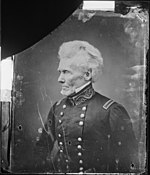

 Date of Birth: 20-Mar-1777
 Place of Birth: Culpeper County, Virginia, United States
Date of Death: 06-Jun-1849
Profession: military personnel
Nationality: United States
Zodiac Sign: Pisces 
About Edmund P. Gaines
- Edmund Pendleton Gaines (March 20, 1777 – June 6, 1849) was a career United States Army officer who served for nearly fifty years, and attained the rank of major general.
- He was one of the Army's senior commanders during its formative years in the early to mid-1800s, and was a veteran of the War of 1812, Seminole Wars, Black Hawk War, and Mexican–American War. A native of Culpeper County, Virginia, he was named for his great-uncle Edmund Pendleton.
- Gaines was educated in Virginia and joined the Army as an ensign in 1799.
- He served for a year before being discharged, but returned to service in 1801 and remained in uniform until his death.
- In the early years of his military career, Gaines carried out important tasks including construction of a federal post road from Nashville, Tennessee to Natchez, Mississippi.
- As commander of Fort Stoddert in 1807, he detained Aaron Burr, and Gaines subsequently testified at Burr's trial for treason.
- During the War of 1812, Gaines advanced through the ranks to colonel as commander of the 25th Infantry Regiment and he fought with distinction at the Battle of Crysler's Farm.
- Gaines was promoted to brigadier general during the war, and received a brevet promotion to major general. Gaines' post-war service included diplomacy with and military engagements against various tribes of Native Americans, though Gaines later opposed Andrew Jackson's Indian removal policy.
- One of his infamous post war actions, as a General of the Federal Army, was the destruction of Negro Fort just over the state boundary in then Spanish held Florida.
- Filled with escaped slaves, the enclave was viewed as a challenge to the authority of nearby states and slavery.
- Residents included more than 270 people, many African Americans who had escaped slavery by running away.
- When the fort was taken they were captured, killed, or enslaved.
- The 1828 death of Jacob Brown, the Army's senior officer, touched off a bitter feud between Gaines and Winfield Scott over which had seniority and the best claim to succeed to command.
- The quarrel became public and President John Quincy Adams decided to bypass both Gaines and Scott to offer the post to Alexander Macomb.
- When Macomb died in 1841, President John Tyler quickly headed off a rekindling of the Gaines–Scott dispute by appointing Scott as the Army's commanding general.
- Gaines continued to serve as a district, department and division commander, but became increasingly marginalized as Scott gained influence. At the start of the Mexican–American War, Gaines was stationed in Louisiana and issued a public call throughout the southern and southwestern states for volunteers to join Zachary Taylor's army.
- He faced a court-martial for recruiting without prior authorization, but successfully defended his actions.
- Gaines died in New Orleans, Louisiana and was buried at Church Street Graveyard in Mobile, Alabama.
Read more at Wikipedia
Image Author, Source and License
Author:
Brady National Photographic Art Gallery (Washington, D.C.) (1858 - ?), Photographer (NARA record: 1135962)
Source: U.S. National Archives and Records Administration
License: CC-PD-Mark
PD US Government
More Details
Mathew Brady
(1822–1896)    |
|||
|---|---|---|---|
 |
|||
| Description | American photographer, war photographer, photojournalist and journalist | ||
| Date of birth/death | 18 May 1822 | 15 January 1896 | |
| Location of birth/death | Warren County | Manhattan | |
| Work period | from 1844 until circa 1887 | ||
| Work location | New York City, Washington, D.C. | ||
| Authority control | |||
Source: U.S. National Archives and Records Administration
License: CC-PD-Mark
PD US Government
More Details