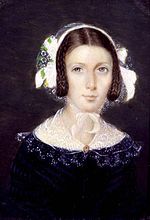

 Date of Birth:
  Place of Birth: London
About Fanny Brawne
- Frances "Fanny" Brawne Lindon (9 August 1800 – 4 December 1865) is best known as the fiancée and muse to English Romantic poet John Keats. As Fanny Brawne, she met Keats, who was her neighbour in Hampstead, at the beginning of his brief period of intense creative activity in 1818.
- Although his first written impressions of Brawne were quite critical, his imagination seems to have turned her into the goddess-figure he needed to worship, as expressed in Endymion, and scholars have acknowledged her as his muse. They became secretly engaged in October 1819, but Keats soon discovered that he was suffering from tuberculosis.
- His condition limited their opportunities to meet, but their correspondence revealed passionate devotion.
- In September 1820, he left for the warmer climate of Rome, and her mother agreed to their marrying on his projected return, but he died there in February 1821, aged twenty-five. Brawne drew consolation from her continuing friendship with Keats' younger sister, who was also called Fanny.
- Brawne later married, and she bore three children, whom she entrusted with the intimate letters Keats had written to her.
- When these were published in 1878, it was the first time the public had heard of Brawne, and they aroused interest among literary scholars.
- But they attracted much venom from the press, which declared her to have been unworthy of such a distinguished figure.
- By contrast, the later publication of Brawne’s letters to Fanny Keats showed her in a more favourable light, greatly improving her reputation.
Read more at Wikipedia