François Chaussier, Date of Birth, Place of Birth, Date of Death
TweetFrançois Chaussier
French anatomist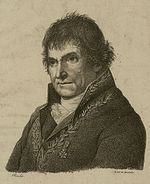

 Date of Birth:
  Place of Birth: Dijon, Bourgogne-Franche-Comté, France
About François Chaussier
- François Chaussier (July 2, 1746 – June 19, 1828) was a French anatomist who was a native of Dijon.
- His name is associated with the Prix Chaussier (Chaussier Prize).He studied medicine in Besançon, later returning to Dijon, where he worked as a hospital physician.
- During this time he performed pioneer research in the field of forensic medicine.
- In 1780 he became a professor of anatomy. In 1794 he was summoned to Paris by Antoine-François Fourcroy (1755–1809), being given the responsibility of drafting a report on the establishment of learning institutions of health.
- This report was presented to the National Convention on November 27, 1794. Afterwards, Chaussier remained in Paris where he became a professor at the École Polytechnique, and a chief obstetrician at the Paris Maternité, where he was a colleague of Jean-Louis Baudelocque (1745–1810).
- In 1822 Chaussier was elected as a member of the Académie des sciences. Chaussier is credited for introducing a procedure for revival of "near-dead" newborns.
- He also performed a descriptive survey of all muscles in the human body, and developed a new system of designation for muscles.
- He also conducted early investigations of neuralgia.
Read more at Wikipedia
See Also
- Famous People's Birthdays on 02 July, France
- Famous People's Birthdays in July, France
- Famous physician's Birthdays on 02 July, France
- Famous physician's Birthdays in July, France
- Famous anatomist's Birthdays on 02 July, France
- Famous anatomist's Birthdays in July, France
- Famous obstetrician's Birthdays on 02 July, France
- Famous obstetrician's Birthdays in July, France
Image Author, Source and License
Author: Berdalle
Source:
License: PD US
More Details
Source:

|
This image is available from the United States Library of Congress's Prints and Photographs division
under the digital ID ppmsca.02193. This tag does not indicate the copyright status of the attached work. A normal copyright tag is still required. See Commons:Licensing for more information.
|
License: PD US
More Details