Edgar de Wahl, Date of Birth, Place of Birth, Date of Death
TweetEdgar de Wahl
Baltic German linguist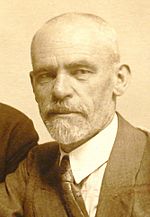

 Date of Birth:
  Place of Birth: Olviopol, Ukraine
About Edgar de Wahl
- Edgar Alexei Robert von Wahl or de Wahl (23 August 1867 – 9 March 1948) was a Baltic German teacher, mathematician and linguist.
- He is most famous for being the creator of Interlingue, a naturalistic constructed language based on the Indo-European languages, which was initially published in 1922. He was born at Olwiopol (according to some sources in Bohopil, a town nearby), Kherson Governorate, Russian Empire (now part of Pervomaisk, Mykolaiv Oblast, Ukraine).
- The family spent some years in Ukraine, since the father of Edgar von Wahl worked there as a railway engineer.
- After that the family stayed some years in Tallinn and moved then to Saint Petersburg.
- Wahl studied there and began after that service in Imperial Russian Navy.
- Since 1894 Wahl worked as a teacher in Tallinn.At first an adherent of Volapük, de Wahl later became one of the first users of Esperanto in 1888 and advised L.
- L.
- Zamenhof on some points of grammar and vocabulary of that language.
- After several years he abandoned Esperanto after the failed vote to reform the language in 1894 (de Wahl was one of the few that voted for a completely new reform), and in the following decades he worked on the problem of the ideal form of an international auxiliary language. In 1922 he published a "key" to a new language, Occidental, and the first number of a periodical entitled Kosmoglott (later Cosmoglotta), written in that language.
- In following years, de Wahl participated in discussions about Occidental, and allowed the language to develop gradually as a result of the recommendations of its users.
- After World War II started in 1939, he had only intermittent contacts with the Occidentalist movement, which had become centred in Switzerland.
- He became a member of the Committee of Linguistic Advisors, part of the International Auxiliary Language Association, which would present Interlingua in 1951. The last years of his life were spent in a psychiatric hospital in Tallinn, Estonia, where he died in 1948. Shortly afterwards, in 1949, the name of Occidental was changed to Interlingue.
- Later, in 1951, Interlingua was unveiled; this led to the present insignificance of Interlingue.
Read more at Wikipedia
See Also
- Famous People's Birthdays on 11 August, Ukraine
- Famous People's Birthdays in August, Ukraine
- Famous People's Birthdays on 11 August, Estonia
- Famous People's Birthdays in August, Estonia
- Famous teacher's Birthdays on 11 August, Ukraine
- Famous teacher's Birthdays in August, Ukraine
- Famous Esperantist's Birthdays on 11 August, Ukraine
- Famous Esperantist's Birthdays in August, Ukraine
- Famous linguist's Birthdays on 11 August, Ukraine
- Famous linguist's Birthdays in August, Ukraine
- Famous Idist's Birthdays on 11 August, Ukraine
- Famous Idist's Birthdays in August, Ukraine
- Famous teacher's Birthdays on 11 August, Estonia
- Famous teacher's Birthdays in August, Estonia
- Famous Esperantist's Birthdays on 11 August, Estonia
- Famous Esperantist's Birthdays in August, Estonia
- Famous linguist's Birthdays on 11 August, Estonia
- Famous linguist's Birthdays in August, Estonia
Image Author, Source and License
Author: Unknown
Source:
License: CC-BY-SA-3.0
GFDL
More Details
Source:
Austrian National Library
  |
|||
|---|---|---|---|
 |
|||
| Native name | Österreichische Nationalbibliothek | ||
| Location | Vienna | ||
| Coordinates | 48° 12' 22.11? N, 16° 21' 58.56? E   | ||
| Established | 1920 | ||
| Web page | onb.ac.at | ||
| Authority control | |||
License: CC-BY-SA-3.0
GFDL
More Details