Edward Evans, 1st Baron Mountevans, Date of Birth, Place of Birth, Date of Death
TweetEdward Evans, 1st Baron Mountevans
Royal Navy admiral
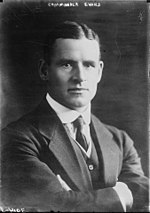

 Date of Birth: 28-Oct-1881
 Place of Birth: London
Date of Death: 20-Aug-1957
Profession: military personnel, politician, explorer
Nationality: United Kingdom
Zodiac Sign: Scorpio 
About Edward Evans, 1st Baron Mountevans
- Edward Ratcliffe Garth Russell Evans, 1st Baron Mountevans (28 October 1880 – 20 August 1957) was a Royal Navy officer and Antarctic explorer.Evans was seconded from the Navy to the Discovery expedition to Antarctica in 1901–1904, when he served on the crew of the relief ship, and afterwards began planning his own Antarctic expedition.
- However, he suspended this plan when offered the post of second-in-command on Robert Falcon Scott's ill-fated Terra Nova expedition to the South Pole in 1910–1913, as captain of the expedition ship Terra Nova.
- He accompanied Scott to within 150 miles of the Pole, but later became seriously ill with scurvy and only narrowly survived the return journey. After the expedition he toured the country giving lectures, and returned to his naval duties as a commander in the summer of 1914.
- He spent the First World War as a destroyer captain, becoming famous as "Evans of the Broke" after the battle of Dover Strait in 1917.
- He commanded a cruiser at Hong Kong in 1921–1922, where he was awarded a medal for his role in rescuing passengers from the wrecked-vessel Hong Moh, and then spent several years commanding the Home Fisheries Protection Squadron before being given command of the modern battlecruiser HMS Repulse.
- He later commanded the Australian Squadron and the Africa Station before becoming Commander-in-Chief, The Nore, one of the Navy's senior Home Commands; during this time, unusually for a serving officer, he was also Rector of the University of Aberdeen. After four years at the Nore, he handed over command in early 1939, and was appointed Civil Defence Commissioner for London during the preparations for the Second World War; after the German invasion of Norway he travelled there to liaise with King Haakon VII, a personal acquaintance.
- He remained in a civil defence role throughout the War, though he had officially retired from the Navy in 1941, and was raised to the peerage in 1945, sitting in the House of Lords as a Labour member.
Read more at Wikipedia
See Also
- Famous People's Birthdays on 28 October, United Kingdom
- Famous People's Birthdays in October, United Kingdom
- Famous military personnel's Birthdays on 28 October, United Kingdom
- Famous military personnel's Birthdays in October, United Kingdom
- Famous politician's Birthdays on 28 October, United Kingdom
- Famous politician's Birthdays in October, United Kingdom
- Famous explorer's Birthdays on 28 October, United Kingdom
- Famous explorer's Birthdays in October, United Kingdom