Luca Arbore, Date of Birth, Date of Death
TweetLuca Arbore
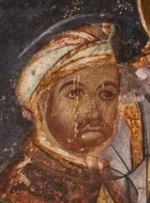

 Date of Birth: 14-Sep-1486
Date of Death: 25-Apr-1523
Profession: REGENTĂ,CONDUCĂTOAREA STATULUI
Zodiac Sign: Virgo 
About Luca Arbore
- Luca Arbore or Arbure (Old Cyrillic: ???? ??????; Renaissance Latin: Herborus or Copacius; died April 1523) was a Moldavian boyar, diplomat, and statesman, several times commander of the country's military.
- He first rose to prominence in 1486, during the rule of Stephen III, Prince of Moldavia, to whom he was possibly related.
- He became the long-serving gatekeeper (or castellan) of Suceava, bridging military defense and administrative functions with a diplomatic career.
- Arbore therefore organized the defense of Suceava during the Polish invasion of 1497, after which he was confirmed as one of Moldavia's leading courtiers.
- As a military commander, Arbore participated in Moldavian's occupation of Pokuttya in 1502.
- He is tentatively identified as "Luca the Vlach", who served Stephen on crucial diplomatic missions to Poland and the Grand Duchy of Moscow.
- Also a great landowner and patron of the arts, Arbore commissioned the painting of Arbore Church.
- The building is one of the eight Moldavian churches on the UNESCO World Heritage list. Gatekeeper Arbore was identified, possibly erroneously, as a pretender to the Moldavian throne in 1505.
- He still served Stephen's son Bogdan III, who needed his services in particular during the Moldavian–Polish border clashes of that year.
- He maintained his position despite suffering defeat, and, possibly as a hetman, went on to serve as tutor of Bogdan's orphaned son, Stephen IV "?tefani?a".
- As such, he aligned the country with Poland and waged war against the Crimean Khanate (a proxy for the Ottoman Empire), winning a major victory at ?tefane?ti in August 1518.
- In 1523, the prince accused the Arbore males of insubordination, and had most of them executed.
- Although the original accusation was probably spurious, the execution itself sparked an actual boyar revolt.
- The Arbore line was largely extinguished in 1523, but survived mainly through female descendants; the name was eventually reused by people who were distantly related to the original family, including, in the late 19th-century, the scholar-politician Zamfir Arbore.
- By then, the gatekeeper had also been recovered as a symbolic figure in the literature of authors such as Bogdan Petriceicu Hasdeu, Mihai Eminescu, and Barbu ?tefanescu Delavrancea.
Read more at Wikipedia