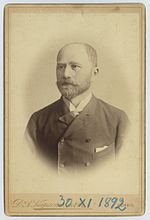

 Date of Birth:
About Dimitar Agura
- Dimitar Dimitrov Agura (Bulgarian: ??????? ???????? ?????; 26 October 1849–11 October 1911) was a Bulgarian historian, one of the first professors of history at Sofia University and a rector of the university. Agura was born to a Bessarabian Bulgarian family in Chushmelia, Bessarabia, then part of the Romania (today Krynychne, Odessa Oblast, Ukraine).
- He started his education in Bolgrad and finished the seminary in Iasi, Romania, in 1868.
- Agura graduated in history from the University of Iasi in 1872.
- He proceeded to work as a teacher in Bârlad (1872–1874) and a school inspector in Iasi and Vaslui.
- For several years, he taught Romanian language and Bulgarian history at the Bolhrad High School (1875–1878). With the Liberation of Bulgaria in 1878, Dimitar Agura arrived in the newly established Principality of Bulgaria and worked as a clerk at the Ministry of Interior (1879–1883).
- He was an interim Minister of Popular Enlightenment in Leonid Sobolev's cabinet (1883).
- After that, he was director of the Sofia (1884–1885) and Plovdiv (1885–1889) men's high schools. The Sofia University was founded in 1888 and Agura became a lecturer of history at the university in 1889.
- He was rector of Sofia University three times (1889–1890, 1892–1895, 1907–1908).
- He was the university's second rector, after fellow Bessarabian Bulgarian Aleksandar Teodorov-Balan.
- In 1900, Agura became an acting member of the Bulgarian Academy of Sciences.
- In 1901, he was among the founders of the Bulgarian Historical Society; he remained its chairman until his death. Dimitar Agura died in 1911 in Iasi, where he was attending the University of Iasi's 50th anniversary celebrations.
Read more at Wikipedia
See Also
- Famous People's Birthdays on 26 October, Bulgaria
- Famous People's Birthdays in October, Bulgaria
- Famous politician's Birthdays on 26 October, Bulgaria
- Famous politician's Birthdays in October, Bulgaria
- Famous historian's Birthdays on 26 October, Bulgaria
- Famous historian's Birthdays in October, Bulgaria