Dmitry Lachinov, Date of Birth, Place of Birth, Date of Death
TweetDmitry Lachinov
Russian scientist
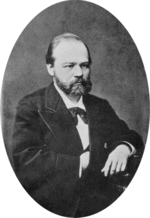

 Date of Birth: 10-May-1842
 Place of Birth: Tambov Governorate
Date of Death: 15-Oct-1902
Profession: engineer, physicist, patent inventor, electrical engineer, meteorologist
Zodiac Sign: Taurus 
About Dmitry Lachinov
- Dmitry Aleksandrovich Lachinov (Russian: ??????? ????????????? ????´???) (10 May 1842 – 15 October 1902) was a Russian physicist, electrical engineer, inventor, meteorologist and climatologist. Dmitry Lachinov studied in the St.
- Petersburg University, where he was a pupil of Heinrich Lenz, Pafnuty Chebyshev and Feodor Petrushevsky.
- In 1862, when the University was closed because of the students' unrest, Lachinov went to Germany and for two and a half years studied there under the guidance of Gustav Kirchhoff, Robert Bunsen and Hermann Helmholtz, attending practical lessons in their laboratories in Heidelberg and Tübingen. In a paper released in 1880, Lachinov became the first one to point out the possibility of electricity transmission over long distances, and to propose the means of achieving it — 18 months before the first publication of the article with similar conclusions by Marcel Deprez. In 1889 Lachinov wrote the first textbook on meteorology and climatology in Russia.
- In its 2nd edition (July 1895) he gave the first description of the lightning detector invented earlier by Alexander Popov (the device was also a prototype of the first practical radio receiver). Lachinov's own inventions include a mercury pump, economizer for electricity consumption, electrical insulation tester (or defectoscope), optical dynamometer, a special types of photometer and electrolyser.
- One of his main achievements was a method of industrial synthesis of hydrogen and oxygen through electrolysis (1888). Dmitry Lachinov is great-grandfather of physical chemist Mikhail Schultz. Lachinov was The Officer of the Order Légion d'honneur.
Read more at Wikipedia
See Also
- Famous People's Birthdays on 10 May, Worldwide
- Famous People's Birthdays in May, Worldwide
- Famous engineer's Birthdays on 10 May, Worldwide
- Famous engineer's Birthdays in May, Worldwide
- Famous physicist's Birthdays on 10 May, Worldwide
- Famous physicist's Birthdays in May, Worldwide
- Famous patent inventor's Birthdays on 10 May, Worldwide
- Famous patent inventor's Birthdays in May, Worldwide
- Famous electrical engineer's Birthdays on 10 May, Worldwide
- Famous electrical engineer's Birthdays in May, Worldwide
- Famous meteorologist's Birthdays on 10 May, Worldwide
- Famous meteorologist's Birthdays in May, Worldwide