
 Date of Birth:
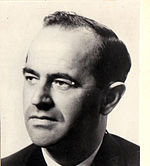
About Alexandru Moghioroș
- Alexandru Moghioro? (Hungarian: Mogyorós Sándor; 23 October 1911 – 1 October 1969) was a Romanian communist activist and politician. Moghioro? was born into an ethnic Hungarian family.
- A worker who joined the Romanian Communist Party (PCR; later PMR) when it was banned, he was tried by the authorities of the Kingdom of Romania at Craiova alongside Ana Pauker and spent time in prison at Jilava, Doftana and Caransebe?.
- While in prison, he grew close to future leader Gheorghe Gheorghiu-Dej, becoming part of a nucleus that would later be at the party's forefront.
- When Gheorghiu-Dej began, by 1950, to move to consolidate his undisputed leadership of the party, he named the trusted Moghioro? to stand guard over and watch for chauvinism in the activities of Vasile Luca, another high-ranking ethnic Hungarian targeted for purging.
- He sat on the party's central committee (1945–1968), its political bureau (1948–1965) and its political executive committee or CPEx (1965–1968).
- He was deputy prime minister during 1954 and from 1957 to 1965.
- As the central committee's secretary for organizational matters during the 1950s, he was one of the architects of the Pauker-Vasile Luca group's fall in May–June 1952.
- He was the de facto overseer of cadre policy and was involved in the collectivization process.In mid-1950, Moghioro? replaced Pauker to become party supervisor of the Agriculture Ministry's agrarian section.
- A year earlier, at a politburo discussion, he was the only member who did not grant even token acknowledgment to the idea that collectivization should happen gradually or cautiously, condemning the "opportunist-conciliatory line" as "non-Leninist, because we can't build socialism without collective farms".
- Once in charge, he sharply criticized Pauker's more lenient approach, holding nightly meetings with officials to decide on new collective farms and ordering a scaled-down plan for the spring be accelerated during the summer of 1950.
- Around 1957, Moghioro? decided that Romania did not have more cattle because the best hay was fed to horses.
- Consequently, he ordered a horse slaughter that claimed some 800,000 animals, which had disastrous consequences in agriculture.
- At the time, horses were still the predominant means of rural transport, and tractors could not be used on farms with clay soil because they became stuck.
- In addition, by closing the stables at Mangalia, Fagara?, Bon?ida and Ru?e?u, he sharply reduced the country's variety of horse breeds.In 1956, following the 20th Congress of the Communist Party of the Soviet Union, some within the PMR, notably Miron Constantinescu and Iosif Chi?inevschi, called for a change in direction that would have threatened Gheorghiu-Dej's position.
- At the time, Moghioro? was among the latter's main allies, along with Gheorghe Apostol, Emil Bodnara? and Petre Borila.
- Constantinescu approached Moghioro? in an attempt to enlist him on his side, which prompted Moghioro? to go to Gheorghiu-Dej immediately and inform him that an "antiparty platform" had arisen.
- As with Borila, Gheorghiu-Dej's successor Nicolae Ceau?escu removed Moghioro? from the party's top body, the permanent presidium, under the pretext of his disease.His wife Stela (born Esther Rado?ove?kaia) was also a longtime party activist and represented the PMR on the editorial board of the Cominform journal For a Lasting Peace, for Popular Democracy.
Read more at Wikipedia