
 Date of Birth:
About Anders Ljungqvist
- Anders Ljungqvist (May 10, 1815 – December 24, 1896), also known as "Gås-Anders" (Anders of the geese), was a Swedish fiddler from Björklinge in Uppland.
- Gås-Anders got his derogatory nickname as a child when he worked as a goose herder at a mansion house in Gamla Uppsala.
- As he grew up he never used the name Gås-Anders, and it was not until the 1920s that folk musicians started referring to him by that name, which was by now used as a positive epithet rather than a slur.Although Gås-Anders made his living by working as a day labourer at the farms around Björklige, he was known as a poor worker who usually brought his fiddle with him and played rather than worked.
- As a spelman he was very popular and extremely skilled, and it was said that nobody could sit still when he played dancing music – not even he himself.
- As he played he would jump around, dancing on chairs and tables.
- Rumour had it that Näcken had taught him to play, signing a contract in blood on human bones from the churchyard.
- According to the stories, Gås-Anders played the polska he had learnt from Näcken on his death bed, after which all four strings on his fiddle broke and he was able to die in peace.
- Another story had it that Gås-Anders's wife once put a Bible on top of his fiddle, and after that it would never stay tuned.Gås-Anders left a legacy of folk music, upwards of 150 different melodies; both tunes he himself had written and those he had learnt from other fiddlers.
- Most of the tunes are eighth-note polskas.
- Since fiddlers at the time played by ear, not from written music (something which is true for traditional folk musicians today as well), much of Gås-Anders's music was never saved for posterity.
- Towards the end of his life he got rather deaf and had to bring a helper to tune his fiddle, but he kept playing at weddings and dances up until the final years of his life.
- He was a poor man when he died, and was buried in the communal part of the churchyard in Björklinge.
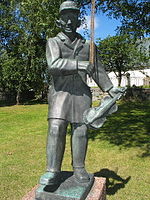
- The exact location of his grave in the churchyard is unknown.In 1944, a statue of Gås-Anders, created by the sculptor Bror Hjorth, was erected next to Björklinge church.
Read more at Wikipedia