Mirza Abdul'Rahim Talibov Tabrizi, Date of Birth, Place of Birth, Date of Death
TweetMirza Abdul'Rahim Talibov Tabrizi
Azerbaijani intellectual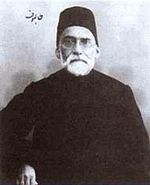

 Date of Birth:
  Place of Birth: Tabriz, East Azerbaijan Province, Iran
About Mirza Abdul'Rahim Talibov Tabrizi
- Mirza Abdul'Rahim Talibi Najjar Tabrizi (1834, Tabriz — 1911, Temir-Khan-Shura, named Buinaksk since 1922) (Persian: ????? ????????? ????? ???? ???????), also known as Talibov, was an Iranian Azerbaijani intellectual and social reformer.
- He was born in the Sorkhab district of Tabriz, Iran.
- Both his father, Abu-Talib Najjar Tabrizi, and grandfather, Ali-Morad Najjar Tabrizi, were carpenters (whence the name Najjar).
- No information concerning the maternal side of his family is available. In 1851, Talibi emigrated to Tbilisi (Tiflis), the administrative capital of the Russian Caucasus, and began a new life there (see Treaty of Gulistan and Treaty of Turkmenchay).
- According to one Iranian source, Talibi attended school in Tbilisi and studied modern sciences, however there is no independent evidence in support of this report.
- It has been suggested that Talibi may in fact never have received a formal education in Russia.
- In a letter written to an Iranian friend, he indicated that he produced his major works through relying on personal reading and self-discipline. In Tbilisi, Talibi worked for an Iranian businessman, named Mohammad-Ali Khan, who had emigrated to Transcaucasia from the city of Kashan.
- Mohammad-Ali Khan was a contractor who had accumulated much of his wealth from obtaining concessions for construction of roads and bridges in Transcaucasia.
- After years of working for the wealthy compatriot, Talibi must have saved a sufficient amount of capital to start his own construction business.
- He also moved from Tbilisi to Temir-Khan-Shura (Buinaksk, since 1922), the provincial capital of Dagestan, where he bought a comfortable house, built a small private library and married a woman from Derbent. Talibi wrote all of his works after the age of fifty-five.
- He had by then attained a degree of financial security that enabled him to devote the next twenty-one years of his life to writing and translating from Russian into Persian.
- With the exception of his last two books, he published all of his works at his own expense.
- Of his last two books, the first, Izahat dar Khosus-e Azadi (Explanations Concerning Freedom), was published in Tehran after the victory of the Iranian Constitutional Revolution of 1906, and the second, Siyasat-e Talibi (Talibian Politics), was published posthumously in Tehran a few months after his death in 1911. During his lifetime, two of Talibi's works, namely Ketab-e Ahmad ya Safineh-ye Talebi (Ahmad's Book or the Talibian Vessel) and Masalek'ol-Moh'senin (The Ways of the Charitable), achieved great eminence.
- Ketab-e Ahmad, which consists of two volumes, was inspired by Jean-Jacques Rousseau's tract on education Emile.
- The book is based on conversations between the author and his fictional seven-year-old son, Ahmad, whose searching and inquisitive mind compels his father to expand on a wide range of scientific, historical, political and religious topics.
- Their dialogue on these issues reveal Talibi's social reformism. The Ways of the Charitable involves four characters: Mustafa and Hossein who are engineers, a physician named Ahmed, and Muhammad who is a chemistry teacher.
- They are appointed by a fictional geographic administration of Iran to travel to Damavand mountain for scientific studies and measurement.
- They encounter a number of spaces and characters on their way—from a mujtahid to a dervish to shoemaker—and these encounters attempt to demonstrate Iran’s problems.
- These problems are political, social, and scientific.
- Kings live in luxury while the country’s infrastructure is crumbling; European cities enjoy wealth and application of sciences while Iranian cities lack them; other nations unite with a spirit of reform and talk at lengths to make their nation a better place while Iranians are silent about their problems, alienated from one another, and set in archaic, ancestral ways; the Qajar ministries are mere imitations without any institutional foundation and government officials are not appointed based on merit; education too is in a poor condition and no books are written for the advancement of sound pedagogy.
Read more at Wikipedia