John Braham (RAF officer), Date of Birth, Place of Birth, Date of Death
TweetJohn Braham (RAF officer)
Pilot

 Date of Birth: 06-Apr-1920
 Place of Birth: Holcombe, Somerset, England, United Kingdom
Date of Death: 07-Feb-1974
Profession: flying ace
Nationality: United Kingdom
Zodiac Sign: Aries 
About John Braham (RAF officer)
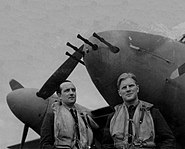
- John Randall Daniel "Bob" Braham, (6 April 1920 – 7 February 1974) was a Royal Air Force (RAF) night fighter pilot and fighter ace during the Second World War. Braham was born in April 1920.
- Upon leaving school as a teenager he worked for his local constabulary as a clerk.
- Bored with civilian life, Braham joined the RAF on a five-year short service commission in December 1937.
- He began basic training in March 1938 and then advanced training from August to December.
- Upon the completion of flight training, he was posted to No.
- 29 Squadron RAF based at RAF Debden, where he learned to fly the Hawker Hurricane and Bristol Blenheim.
- In 1939 the squadron began to organise itself as a specialised night fighter unit. By August 1940, the Battle of Britain was underway.
- He gained his first victory on 24 August, which remained his only success in the battle.
- In September 1940, No.
- 29 Squadron was re-equipped with the Bristol Beaufighter.
- Braham continued operations during "The Blitz", claiming the destruction of two more enemy aircraft.
- By the end of 1940 he had been awarded the Distinguished Flying Cross (DFC). Braham continued to operate as an anti-intruder pilot after the Blitz ended in May 1941.
- He became an ace in September 1941, having achieved five victories, and was awarded a bar to his DFC in November 1941.
- In June 1942 he was promoted to squadron leader.
- By October 1942 Braham had claimed 12 enemy aircraft destroyed and he was awarded the Distinguished Service Order (DSO).
- Braham also flew missions with RAF Coastal Command during this time and claimed a U-boat damaged and an E-boat destroyed.
- He was then promoted to wing commander and given command of No.
- 141 Squadron RAF.
- Braham undertook more intruder sorties into German-occupied Europe at this point and received a second bar to his DFC in June 1943 and by September 1943 had gained seven more victories, including three, possibly four, German night fighter aces.
- Consequently, he was awarded a bar to his DSO. The squadron soon converted to the De Havilland Mosquito and in February 1944 Braham was transferred to the operations staff at No.
- 2 Group RAF but was permitted to fly one operation per week.
- He achieved nine victories in the Mosquito and in June 1944 was awarded a second bar to his DSO.
- Braham's war came to an end on 24 June 1944 when he was shot down by a pair of single-engine German Focke-Wulf Fw 190 fighters.
- Braham was captured and spent the rest of the war as a prisoner.
- He was liberated in May 1945. Braham was the most highly decorated airman in RAF Fighter Command.
- He claimed the destruction of 29 enemy aircraft.
- In addition, he claimed a further six damaged and four probable victories.
- One of these probable victories can be confirmed through German records, making an unofficial total of 30 enemy aircraft destroyed.
- Nineteen were achieved at night.
- He was the most successful British pilot on twin-engine aircraft.
- The 19 victories claimed at night rivalled John "Cats Eyes" Cunningham's tally and was bettered only by night fighter pilot Branse Burbridge.After the war he was offered a permanent commission, which he initially accepted.
- Having resigned his commission in March 1946 he re-enlisted briefly.
- After struggling to find a career that would support his family, Braham emigrated to Canada with his family and enlisted in the Royal Canadian Air Force (RCAF) in 1952.
- Having held office at the Supreme Headquarters Allied Powers Europe, Braham retired from military life and began working as a civilian for the Department of Indian Affairs and Northern Development.
- He continued to work there until his death from an undiagnosed brain tumor in 1974, aged 53.
Read more at Wikipedia