Duncan Cameron (British Army officer), Date of Birth, Place of Birth, Date of Death
TweetDuncan Cameron (British Army officer)
British Army general
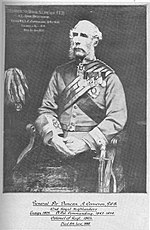

 Date of Birth: 20-May-1808
 Place of Birth: Hampshire, England, United Kingdom
Date of Death: 08-Jun-1888
Profession: military personnel
Zodiac Sign: Taurus 
About Duncan Cameron (British Army officer)
- General Sir Duncan Alexander Cameron, (20 May 1808 – 8 June 1888) was a British Army officer who fought in the Crimean War and during part of the New Zealand Wars.
- He was later a governor of the Royal Military College, Sandhurst. Born into a family with a military tradition, he joined the British Army in 1825.
- Commissioned into the 42nd Regiment of Foot, he had risen to the rank of lieutenant-colonel by 1854 and was a battalion commander.
- He served in the Crimean War and fought in the Battle of Alma.
- Afterwards, he assumed command of the Highland Brigade and led it through the Battle of Balaclava and the Siege of Sevastopol.
- He finished the war as a temporary major-general and received several honours for his service.
- He then held a series of educational and advisory posts with the British Army before becoming Commander-in-Chief, Scotland in 1860. The following year, Cameron was appointed commander of British forces in New Zealand, which was dealing with the ongoing New Zealand Wars.
- At the time, the Colonial Government was engaged in a conflict with the Maori in the Taranaki region.
- However, by the time Cameron arrived in the Taranaki, a truce had been arranged.
- Two years later, he suppressed a further outbreak of fighting in the area and then led the invasion of the Waikato to deal with the King Movement, a Maori resistance that threatened British sovereignty in the country.
- He commanded a series of mostly successful engagements with the Kingites, followers of the King Movement, but none were decisive.
- By March 1864, he had advanced in the Waikato heartland and had pushed the Kingites into the King Country.
- At Gate Pa in April 1864, his forces suffered a major defeat.
- By this stage, Cameron was becoming disillusioned with the conduct of the war.
- Against his wishes, in early 1865 he commanded a campaign against Maori in the southern Taranaki.
- Coming under political pressure to wage a war he felt was inappropriate, he tendered his resignation and left New Zealand in August 1865. In 1868, Cameron was made a lieutenant-general and was appointed as governor of the Royal Military College at Sandhurst.
- He remained in this post until 1875, at which time he retired from military service with the rank of general and as a Knight Grand Cross of the Order of the Bath.
- He died in 1888 at the age of 80.
Read more at Wikipedia