George Barbu Știrbei, Date of Birth, Place of Birth, Date of Death
TweetGeorge Barbu Știrbei
Romanian politician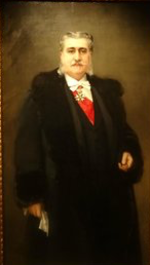

 Date of Birth:
  Place of Birth: Bucharest
About George Barbu Știrbei
- George Barbu ?tirbei or ?tirbeiu, also known as Gheorghe, Georgie, or Iorgu ?tirbei (Francized Georges Stirbey; April 1, 1828 – August 15, 1925), was a Wallachian-born Romanian aristocrat and politician who served as the Minister of Foreign Affairs from July 15, 1866 until February 21, 1867.
- He was the eldest son of Barbu Dimitrie ?tirbei, Prince of Wallachia, and the nephew of his rival, Gheorghe Bibescu; his younger siblings included the landowner and industrialist Alexandru B.
- ?tirbei.
- Educated in France, he returned to Wallachia during his father's princely mandate, as a Beizadea and aspiring politician.
- Fleeing his country during the Crimean War, he served the French Empire before returning home to become Wallachian Minister of War and Spatharios.
- He is remembered for reforming the Wallachian militia during the remainder of Prince Barbu's term. ?tirbei remained a legislator of Wallachia and then of the United Principalities.
- He was however strongly opposed to the Principalities' first Domnitor, Alexandru Ioan Cuza, reemerging by 1860 as a charismatic leader of the conservative opposition.
- His involvement in political scandals and electoral intrigues led to his brief arrest that same year, but Cuza was ultimately toppled in 1866.
- Following this, ?tirbei abandoned his own bid for the throne to serve Domnitor Carol of Hohenzollern.
- As Foreign Minister, he helped secure recognition for the United Principalities, and made diplomatic overtures toward Austria-Hungary.
- Failing in his attempt to become Prime Minister of Romania, he was disappointed with the Domnitor, leaving politics altogether. ?tirbei divided the second half of his life between homes in Paris and Bécon-les-Bruyères, and was naturalized French.
- In this period, he was a collector and patron of the arts, noted as Jean-Baptiste Carpeaux's last-ever sponsor.
- He was also married to the actress and sculptor Valérie Simonin, adopting her daughters Consuelo and Georges Achille Fould—whom he educated artistically.
- His parallel work was as a cultural journalist, and, late in his life, as the posthumous editor of Jean-Jacques Weiss and as a memoirist.
- His controversial dealings with Carpeaux, the status of his inheritance, and his paternity disputes remained at the center of public attention long after his death.
Read more at Wikipedia
See Also
- Famous People's Birthdays on 01 April, Romania
- Famous People's Birthdays in April, Romania
- Famous military personnel's Birthdays on 01 April, Romania
- Famous military personnel's Birthdays in April, Romania
- Famous politician's Birthdays on 01 April, Romania
- Famous politician's Birthdays in April, Romania
- Famous diplomat's Birthdays on 01 April, Romania
- Famous diplomat's Birthdays in April, Romania
- Famous biographer's Birthdays on 01 April, Romania
- Famous biographer's Birthdays in April, Romania
- Famous literary critic's Birthdays on 01 April, Romania
- Famous literary critic's Birthdays in April, Romania
- Famous art collector's Birthdays on 01 April, Romania
- Famous art collector's Birthdays in April, Romania
Image Author, Source and License
Author:
Source: Musée Roybet Fould
License: CC-PD-Mark
PD-old-70-expired
More Details
Georges Achille-Fould
(1868–1951)   |
|||
|---|---|---|---|
.jpg) |
|||
| Alternative names | George Achille-Fould; George-Achille Fould-Stirbey; Achille-Fould | ||
| Description | French painter | ||
| Date of birth/death | 1868 | 24 August 1951 | |
| Location of birth/death | Asnières-sur-Seine | Brussels metropolitan area | |
| Work location | Paris (1880–1951) | ||
| Authority control | |||
Source: Musée Roybet Fould
License: CC-PD-Mark
PD-old-70-expired
More Details