George Lavington, Date of Birth, Place of Birth, Date of Death
TweetGeorge Lavington
British bishop

 Date of Birth: 18-Jan-1684
 Place of Birth: Mildenhall, Wiltshire, England, United Kingdom
Date of Death: 13-Sep-1762
Profession: priest
Zodiac Sign: Capricorn 
About George Lavington
- George Lavington (18 January 1684 – 13 September 1762) was a Bishop of Exeter from 1746 to 1762. Born in Mildenhall, Wiltshire to Rev Joseph Lavington and his wife Elizabeth née Constable, he was educated at New College, Oxford (becoming a fellow in 1708) and later appointed Chaplain to King George I.
- He served as a Prebendary at Worcester Cathedral.
- Later, he served as Weldland Prebendary at St Paul's Cathedral, London.
- On 8 February 1746, he was consecrated Bishop of Exeter at Lambeth Palace, which post he held until death. He was an ardent opponent of Methodism.
- On being appointed bishop of Exeter, which included Cornwall, one of his first acts was to close the pulpits of North Cornwall to Methodists.
- He also produced a stream of letters and pamphlets attacking Methodism and John Wesley.
- One of these pamphlets contained an accusation against John Wesley concerning his conduct with women, and in particular that he had made indecent advances to the maid of a Mrs Morgan at Mitchell in Cornwall.
- When Wesley investigated he found that Mrs Morgan was merely a gossip, and that Lavington had never troubled to verify the truth of the statements.
- Lavington also attacked George Whitfield, although their relations were better and Lavington once came with his clergy to hear Whitfield preach. A reconciliation took place between the Bishop and John Wesley when they had dinner together on 29 August 1762 after receiving the Sacrament together in Exeter Cathedral.
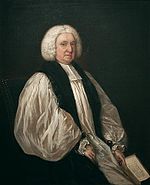
- The Prelate died a fortnight later. A portrait painting of Lavington from the early 1760s by Thomas Gainsborough survives. An epitaph by Subdean Barton survives on a tablet behind the sedilia in the south aisle of Exeter Cathedral, describing him as a pattern for Christian bishops.
Read more at Wikipedia
Image Author, Source and License
Author:
Source: http://collection.aucklandartgallery.govt.nz/collection/images/display/M-1981/M1960_1.jpg
License: CC-PD-Mark
PD-Art (PD-old-100)
More Details
Thomas Gainsborough
(1727–1788)     |
|||
|---|---|---|---|
 |
|||
| Description | British painter, engraver and draughtsman | ||
| Date of birth/death | 14 May 1727 | 2 August 1788 | |
| Location of birth/death | Sudbury | London | |
| Work location | Sudbury, London, Ipswich, Bath | ||
| Authority control | |||
Source: http://collection.aucklandartgallery.govt.nz/collection/images/display/M-1981/M1960_1.jpg
License: CC-PD-Mark
PD-Art (PD-old-100)
More Details