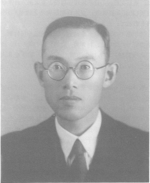

 Date of Birth:
  Place of Birth: Tokyo, Japan
About Yanosuke Otsuka
- Yanosuke Otsuka (Japanese: ?????) (11 July 1903 – 7 August 1950) was a Japanese geologist and professor.Yanosuke Otsuka was born in Nihonbashi, Tokyo on 11 July 1903.
- He went to the Junior High School attached to Tokyo Higher Normal School, and after that to Shizuoka High School.
- For his undergraduate studies, he entered the Department of Geology, Faculty of Science, Imperial University of Tokyo, where he graduated in 1929.
- While he was student, he learned the methods of historical geology from Yoshiaki Ozawa, topography from Taro Tsujimura (????), and Cenozoic biological stratigraphy from Shigeyasu Tokunaga (????).
- After graduation, he entered the Earthquake Research Institute as an assistant in 1930, becoming an associate professor in 1939 and a professor in 1943.
- He made significant contributions in characterizing the surface faults in the circum-Pacific area, effects of tsunamis, tectonics of crustal movements, taxonomy of molluscs, paleoclimatology, mapping of Cenozoic strata, and the Tertiary history of the Japanese islands.
- He died prematurely from pulmonary tuberculosis on 7 August 1950, at the age of 47, because effective antimicrobial therapy was not yet available in Japan at the time.In biology, he is known for the Otsuka similarity coefficient (also known as Otsuka-Ochiai or Ochiai coefficient), which can be represented as: K = | A n B | | A | × | B | {\displaystyle K={\frac {|A\cap B|}{\sqrt {|A|\times |B|}}}} Here, A {\displaystyle A} and B {\displaystyle B} are sets, and | A | {\displaystyle |A|} is the number of elements in A {\displaystyle A} .
- If sets are represented as bit vectors, the Otsuka similarity coefficient can be seen to be the same as the cosine similarity.
Read more at Wikipedia