Louis XII of France, Date of Birth, Place of Birth, Date of Death
TweetLouis XII of France
King of France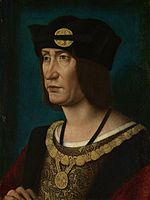

 Date of Birth:
  Place of Birth: Blois, Centre-Val de Loire, France
About Louis XII of France
- Louis XII (27 June 1462 – 1 January 1515) was King of France from 1498 to 1515 and King of Naples from 1501 to 1504.
- The son of Charles, Duke of Orléans, and Maria of Cleves, he succeeded his cousin Charles VIII, who died without a closer heir in 1498.
- Before his accession to the throne of France, he was known as Louis of Orléans and was compelled to be married to his disabled and supposedly sterile cousin Joan by his second cousin, King Louis XI.
- By doing so, Louis XI hoped to extinguish the Orléans cadet branch of the House of Valois.Louis of Orléans was one of the great feudal lords who opposed the French monarchy in the conflict known as the Mad War.
- At the royal victory in the Battle of Saint-Aubin-du-Cormier in 1488, Louis was captured, but Charles VIII pardoned him and released him.
- He subsequently took part in the Italian War of 1494–1498 as one of the French commanders. When Louis XII became king in 1498, he had his marriage with Joan annulled by Pope Alexander VI and instead married Anne of Brittany, the widow of his cousin Charles VIII.
- This marriage allowed Louis to reinforce the personal Union of Brittany and France. Louis persevered in the Italian Wars, initiating a second Italian campaign for the control of the Kingdom of Naples.
- Louis conquered the Duchy of Milan in 1500 and pushed forward to the Kingdom of Naples, which fell to him in 1501.
- Proclaimed King of Naples, Louis faced a new coalition gathered by Ferdinand II of Aragon and was forced to cede Naples to Spain in 1504. Louis XII did not encroach on the power of local governments or the privileges of the nobility, in opposition with the long tradition of the French kings to attempt to impose absolute monarchy in France.
- A popular king, Louis was proclaimed "Father of the People" (French: Le Père du Peuple) in 1506 by the Estates-General of Tours for his reduction of the tax known as taille, legal reforms, and civil peace within France. Louis, who remained Duke of Milan after the second Italian War, was interested in further expansion in the Italian Peninsula and launched a third Italian War (1508–1516), which was marked by the military prowess of the Chevalier de Bayard. Louis XII died in 1515 without a male heir.
- He was succeeded by his cousin and son-in-law Francis from the Angoulême cadet branch of the House of Valois.
Read more at Wikipedia
Image Author, Source and License
Author:
Source: Windsor, collections de S.M. la Reine d'Angleterre
License: CC-PD-Mark
PD-Art (PD-old-100-expired)
PD-old-100-expired
More Details
Workshop of Jean Perréal
(–1530)   |
|||
|---|---|---|---|
 |
|||
| Alternative names | Jehan Perréal Jean de Paris | ||
| Description | French illuminator, painter and architect | ||
| Date of birth/death | 1455/1460 | 1528 | |
| Location of birth/death | Paris | Melun | |
| Work location | Lyon | ||
| Authority control | |||
Source: Windsor, collections de S.M. la Reine d'Angleterre
License: CC-PD-Mark
PD-Art (PD-old-100-expired)
PD-old-100-expired
More Details