Stanisław Mokronowski, Date of Birth, Place of Birth, Date of Death
TweetStanisław Mokronowski
Polish noble and general
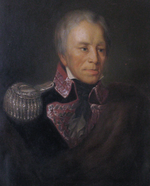

 Date of Birth: 10-Jan-1761
 Place of Birth: Bogucin, Kuyavian-Pomeranian Voivodeship, Kuyavian-Pomeranian Voivodeship, Poland
Date of Death: 19-Oct-1821
Profession: civil engineer
Zodiac Sign: Capricorn 
About Stanisław Mokronowski
- Stanislaw Mokronowski (1761, in Bogucin – 1821, in Warsaw) was a prominent member of the Polish landed gentry of Bogoria coat of arms.
- A general of the Polish Army and a royal Chamberlain[1], Mokronowski took part in both the Polish–Russian War of 1792 (War in the Defence of the Constitution) and Kosciuszko's Uprising of 1794. Stanislaw Mokronowski was born in 1761 to Ludwik Mokronowski and Józefa née Czosnowska.
- Educated by Jesuits, he later studied at the Szkola Rycerska (Knight's School, also known as the Cadet Corps) in Warsaw, and later in Paris.
- He entered the military service in Poland, but for a few years he served in the French military.
- He returned to Poland in 1788, and on the sejmik at Wyszogród land he was elected the deputy to the national Sejm (parliament), thus becoming a member of the famous Great Sejm[2].
- He became allied to the Poniatowski family. In 1792, during the War in the Defence of the Constitution he held the rank of vicebrigadier (wicebrygadier), and after distinguishing himself at the battle of Zielence was promoted to the rank of Lieutenant General.
- In 1793, he married Maria Marianna Sanguszko-Kowelska. In 1794, he was the commander of Polish troops in Warsaw, and took part in the Warsaw Uprising against the Russian garrison occupying the city.
- The Russians were defeated in two days, and retreated from the city with very heavy losses.
- During the insurrection he held the position of commander of the city of Warsaw and the National Forces of the Masovian Duchy (komendant miasta Warszawy i Sily Zbrojnej Ksiestwa Mazowieckiego).
- He was elected to the Provisional Temporary Council (Polish: Rada Zastepcza Tymczasowa), but due to his criticism of Tadeusz Kosciuszko he was removed from the political body.
- As a military commander, he was important in the defense of Warsaw (commander of the defense at the battle of Blonie), and in Lithuania, where he led the retreating Polish forces towards Warsaw.
- Together with prince Józef Poniatowski, Michal Wielhorski and Eustachy Sanguszko, he formed the core of the "court" faction among the insurrectionists. After the defeat of the Uprising, he retired to Italy.
- In 1804 his daughter, Antonina Mokronowski, was born.
- He returned to Poland shortly before his death.
- He was engaged in the construction of the monument of Józef Poniatowski in Warsaw. In 1792, he became the fourth person to receive the Virtuti Militari order (the highest Polish military decoration), after prince Józef Poniatowski, Tadeusz Kosciuszko and Michal Wielhorski.
Read more at Wikipedia