Irving Stringham, Date of Birth, Place of Birth, Date of Death
TweetIrving Stringham
American mathematician
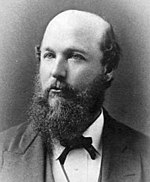

 Date of Birth: 10-Dec-1847
 Place of Birth: Yorkshire (town), New York, New York, United States
Date of Death: 05-Oct-1909
Profession: mathematician
Nationality: United States
Zodiac Sign: Sagittarius 
About Irving Stringham
- Washington Irving Stringham (December 10, 1847 – October 5, 1909) was a "Professor of Mathematics and Sometime Dean in the University of California" born in Yorkshire, New York.
- Stringham was the first person to denote the natural logarithm as ln ? ( x ) {\displaystyle \ln(x)} where x {\displaystyle x} is its argument.
- The use of ln ? ( x ) {\displaystyle \ln(x)} in place of log e ? ( x ) {\displaystyle \log _{e}(x)} is commonplace in digital calculators today. "In place of e log {\displaystyle ^{e}\log } we shall henceforth use the shorter symbol ln {\displaystyle \ln } , made up of the initial letters of logarithm and of natural or Napierian." Stringham graduated from Harvard College in 1877.
- He earned his PhD from Johns Hopkins University in 1880.
- His dissertation was titled Regular Figures in N-dimensional Space under his advisor James Joseph Sylvester. In 1881 he was in Schwartzbach, Saxony, when he submitted an article on finite groups found in the quaternion algebra.Stringham began his professorship in mathematics at Berkeley in 1882.
- In 1893 in Chicago, his paper Formulary for an Introduction to Elliptic Functions was read (but not by him) at the International Mathematical Congress held in connection with the World's Columbian Exposition.
- In 1900 he was an Invited Speaker at the ICM in Paris.
Read more at Wikipedia