J. Vance Lewis, Date of Birth, Date of Death
TweetJ. Vance Lewis
American autobiographer
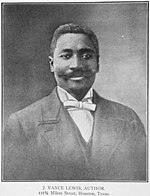

 Date of Birth: 25-Dec-1853
Date of Death: 24-Apr-1925
Profession: lawyer, autobiographer
Nationality: United States
Zodiac Sign: Capricorn 
About J. Vance Lewis
- Joseph Vance Lewis (December 25, 1853? - April 24, 1925), was a slave who was freed through emancipation and who came "out of the ditch" to become a lawyer and was admitted to the US Supreme Court.
- Lewis wrote an autobiographical narrative entitled Out of the Ditch.
- A True Story of an Ex-Slave.{{efn|The introduction describes Lewis's intentions in writing his autobiography: The readers of this book may think it strange that we call it "Out of the Ditch," but it is a description of actual scenes and occurrences.
- Under slave conditions the author would have lived and died, both figuratively and actually, "in the ditch." Under condition of emancipation there was a chance to climb out and fight for life and liberty.
- This book contains a picture of slavery on a gigantic scale.
- There were many slave owners who were as thoughtful and as sympathetic as Mr.
- Cage and his son.
- There were some who were not and this difference in temperament as well as the difference of wealth and blood, led to the paradoxical views which the world held of slavery.
- I have written this little book not because I felt that there was serious need of another book, nor because I wish to boast of my own personal achievement, but because I felt that my struggles might inspire other boys to pursue their highest aspirations and be proof against discouragement.
- The stumbling blocks placed in my pathway may be laid in yours and if this book helps you to avoid them it will have accomplished its mission.
- I felt that "Out of the Ditch" might shed new light upon some of the difficult phases of the Negro problem, and might be the means of helping to change certain adverse conditions for the better.
- You will find some mistakes in the book, you may intice its leteran merits, but I am sure you will approve of its sincerity.
- Naturally in a work of this kind I have employed a good bit of ego, but I saw no way to avoid it in a simple relation of facts.
- Beseeching you to read carefully, and ponder thoughtfully every phase of the author's struggles and the causes therefor, whether of prejudice, jealousy, envy or conspiracy, we send this book into the world.
- Deal with it charitably and try to see the good rather than the bad it may contain.
- Into the warp and woof of every book the author weaves much that even the subtlest readers cannot fathom, far less understand.
- To such it is but a cross and a tangle of threads, but there is a golden thread running through the whole.
- Follow it and you will enter the spirit of "Out of the Ditch."
Read more at Wikipedia
See Also
- Famous People's Birthdays on 25 December, United States
- Famous People's Birthdays in December, United States
- Famous lawyer's Birthdays on 25 December, United States
- Famous lawyer's Birthdays in December, United States
- Famous autobiographer's Birthdays on 25 December, United States
- Famous autobiographer's Birthdays in December, United States