
 Date of Birth:
About James David Edgar
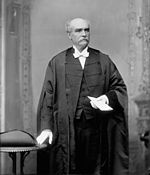
- Sir James David Edgar, (August 10, 1841 – July 31, 1899) was a Canadian politician. In his twenties, Edgar was a law student, legal editor of the Toronto Globe, an alderman on Toronto's city council and an organizer for the Liberal Party in Ontario.
- He was also rare among English Canadians of the time for his sympathy for the rights of French-Canadians.
- Edgar was married to Matilda Ridout and together they had nine children. Born in Hatley, Canada East (later Quebec), Edgar was educated in Lennoxville and Quebec City.
- He moved to Toronto as an adult and became a lawyer in 1864.
- He was elected an alderman in 1866, and was a supporter of George Brown and the Reform Party.
- He ran as a Liberal in the 1871 Ontario provincial election, but was defeated by a margin of four votes in his attempt to win a seat in the provincial legislature. He was first elected to the House of Commons of Canada in the 1872 federal election, and became Whip in the caucus of Alexander Mackenzie.
- He helped bring down the Conservative government over the Pacific Scandal.
- However, despite the election of a Liberal government in the ensuing election, Edgar was defeated in his own riding. In 1874, he started a railway company called the Ontario and Pacific Junction Railway.
- This was an attempt to build a line between Toronto and Lake Nipissing.
- In 1881, it was renamed the Ontario and Sault Ste.
- Marie Railway.
- Both ventures failed to win a contract.
- Fred Cumberland, a partner in the O&PJR venture, formed a rival company called the Northern and Pacific Junction Railway.
- In 1888, the N&PJR merged with the Grand Trunk Railway. Edgar was undaunted by these setbacks and in 1889 started a new company called the Belt Line Railway in Toronto.
- The city's steep ravines made access to some areas very difficult.
- The land developers of these areas required either a commuter railway or a system of bridges to ease access to their properties for buyers.
- This new venture sought to build a commuter rail line in Toronto connecting downtown with undeveloped neighbourhoods as far north as Eglinton Avenue between the Don River and the Humber River.
- Eventually two rail loops were built with 44 stations in total.
- The passenger railway opened in 1892 but ran for only two years, four months before going bankrupt.
- (The city built bridges, eventually.) He used his experience to become the Liberal's railway critic when he returned to Parliament (and the Opposition benches) through an 1884 by-election. In the 1880s, Edgar became a vocal opponent of the Protestant Protective Association, an anti-Catholic political party associated with the Ontario Conservative Party.
- He argued in favour of tolerance and cooperation between English and French Canadians as well as between Protestants and Catholics.
- He also argued against the concept of Imperial Federation, for greater Canadian independence from Britain, and in favour of reciprocity with the United States. When the Liberals formed a government under Sir Wilfrid Laurier following the 1896 federal election, Edgar was nominated to become Speaker of the House of Commons of Canada, and was given a knighthood by Queen Victoria.
- Edgar was in poor health, however, and died in 1899 prior to the end of this term.
Read more at Wikipedia
Image Author, Source and License
Author: Topley Studio
Source:
License: PD Canada
More Details
Source:

|
This image is available from Library and Archives Canada under the reproduction reference number PA-025632 and under the MIKAN ID number 3215251 This tag does not indicate the copyright status of the attached work. A normal copyright tag is still required. See Commons:Licensing for more information. Library and Archives Canada does not allow free use of its copyrighted works. See Category:Images from Library and Archives Canada. |

|
License: PD Canada
More Details