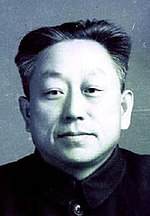

 Date of Birth:
  Place of Birth: Primorskaya Oblast
About Zhu Dehai
- Zhu Dehai (Chinese: ???; Korean: ???; March 5, 1911 – July 3, 1972) was a Korean Chinese revolutionary, educator, and politician of the People's Republic of China.
- He served as a political commissar of the Eighth Route Army during the Second Sino-Japanese War.
- Later he became the first governor of Yanbian Korean Autonomous Prefecture and was in office from 1952 to 1965.
- He also served as the member of the National People's Congress (NPC) for several years.
- He is known as a political moderate and defied orders from the party during the Great Leap Forward while maintaining a close relationship with North Korean government.
- His affiliation with the North Korean leadership eventually led him to downfall.
- During the Cultural Revolution, the Red Guards stigmatized Zhu as a North Korean spy, an accusation that expelled him from all political positions. As a Korean minority high-ranking cadre, he contributed to improve the social status of Korean minority in China.
- His support for Korean's autonomy in northeastern China culminated in the establishment of Yanbian Korean autonomous prefecture in 1952.
- He also paid attention to the education for Korean Chinese.
- When he was in Yan'an, he was one of the founder of the Military and Political University for Korean Revolution (Chinese: ????????; Korean: ????????).
- He also played a crucial role in the establishment of Yanbian University, the first university in Yanbian prefecture. Born as the son of a poor Korean farmer who immigrated to the Primorsky Krai region of Russian Empire in 1911, he developed into an ardent communist, studying in a local school ran by a Korean communist group.
- As a member of Chinese Communist Party, he took part in a series of guerrilla activities against the Japanese invasion of Manchuria in 1931.
- In 1935, following party's order, he went to Moscow to study at the Communist University of the Toilers of the East and graduated in 1938. Later he joined Yan'an’s Chinese Communist Party headquarters, and undertook a position in the education department for the Korean Chinese minority in China.
- In October 1945, after the defeat of Japan in the Second World War, Zhu led a vanguard army to claim the former Manchurian territory.
- During the Chinese Civil War, he led the organization of a voluntary battalion of Korean communists and occupied Harbin along with the People's Liberation Army.
- Zhu's prominence, formerly not conspicuous in the party, emerged dramatically by virtue of his exploit in the northeastern province during the Chinese Civil War. In 1949, shortly before the foundation of the People's Republic of China, Chinese Communist Party appointed him as the first secretary of the Yanbian Local Committee of the Communist Party, which represented the whole Korean minority in northeastern China.
- His career among the Korean minority culminated in power in 1952 as he was inaugurated as the first governor of the freshly established Yanbian Korean Autonomous Prefecture.
- Simultaneously, he enjoyed the elevation of political influence in the central politics of China.
- In 1954, he was appointed as the vice governor of Jilin Province and elected as the first member of the National People's Congress.
- He had served as the member of the Committee for three periods in a row until the Cultural Revolution. In 1966, Zhu became the target of criticism by the Red Guards in Yanbain province.
- Mobilized by Mao Yuanxin, a cousin of Mao Zedong, Red Guards condemned him of treason.
- Also, the Red Guards accused him of the “Top Capitalist” in the province.
- He resigned from the seat in 1966 and sent down (Pinyin: xiafang) to Hubei province.
- He died there from lung cancer in 1972. After the demise of Mao and the subsequent downfall of the Gang of Four, Zhu Dehai was posthumously rehabilitated officially in 1978.
- In 2007, his remains buried in Wuhan were sent back to Yanji.
Read more at Wikipedia