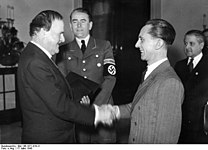

 Date of Birth:
  Place of Birth: Eltville am Rhein, Hesse, Germany
About Wilhelm Kreis
- Wilhelm Kreis (17 March 1873 – 13 August 1955) was a prominent German architect and professor of architecture, active through four political systems in German history: the Wilhelmine era, the Weimar Republic, the Third Reich, and the foundation of the Federal Republic.
- Kreis was born in Eltville am Rhein in Hesse-Nassau.
- He first came to prominence with his 1896 submission for the Völkerschlachtdenkmal in Leipzig, although the commission went to Bruno Schmitz.
- Around the turn of the century, Kreis designed 58 of the Bismarck Towers, a number of civic projects in Dresden, the 1924 William Marx house, and other significant projects.
- The 1926 Rheinhalle (today:Tonhalle Düsseldorf) in Düsseldorf was his first major cultural project, followed by the German Hygiene Museum in Dresden.
- As opposed to the modernist movement then emerging, Kreis was among those architects like Heinrich Tessenow and Paul Bonatz who continued to work in a historical, conservative style. Kreis was dismissed from the presidency of the League of German Architects (BDA) in 1933 and he saw his commissions dry up as a result.
- But within two years he was again working, under the direction of Albert Speer, for war projects in Dresden and the gigantic plans for Berlin, notably the design for the massive Soldiers Hall.
- Employing the respected Kreis brought Speer some legitimacy; Kreis responded by becoming an active supporter of National Socialism.
- He was named as one of the Reich's most important artists in the Gottbegnadeten list of September 1944.
- In the postwar period, Kreis continued to receive commissions despite his advanced age.
Read more at Wikipedia
See Also
- Famous People's Birthdays on 17 March, Germany
- Famous People's Birthdays in March, Germany
- Famous architect's Birthdays on 17 March, Germany
- Famous architect's Birthdays in March, Germany
- Famous university teacher's Birthdays on 17 March, Germany
- Famous university teacher's Birthdays in March, Germany
Image Author, Source and License
Author:
Source:
License: CC-BY-SA-3.0-DE
More Details
Unknown
Source:

|
This image was provided to Wikimedia Commons by the German Federal Archive (Deutsches Bundesarchiv) as part of a cooperation project. The German Federal Archive guarantees an authentic representation only using the originals (negative and/or positive), resp. the digitalization of the originals as provided by the Digital Image Archive. |
License: CC-BY-SA-3.0-DE
More Details