Genghis Khan, Date of Birth, Place of Birth, Date of Death
TweetGenghis Khan
founder and first emperor of the Mongol Empire
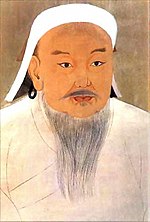

 Date of Birth: 16-Apr-1162
 Place of Birth: Delüün Boldog, Mongolia
Date of Death: 25-Aug-1227
Profession: tribal chief, military leader
Zodiac Sign: Aries 
About Genghis Khan
- Genghis Khan (born Temüjin, c.?1162 – August 18, 1227) was the founder and first Great Khan of the Mongol Empire, which became the largest contiguous empire in history after his death.
- He came to power by uniting many of the nomadic tribes of Northeast Asia.
- After founding the Empire and being proclaimed Genghis Khan, he launched the Mongol invasions that conquered most of Eurasia.
- Campaigns initiated in his lifetime include those against the Qara Khitai, Caucasus, and Khwarazmian, Western Xia and Jin dynasties.
- These campaigns were often accompanied by large-scale massacres of the civilian populations, especially in the Khwarazmian– and Western Xia–controlled lands.
- By the end of his life, the Mongol Empire occupied a substantial portion of Central Asia and China. Before Genghis Khan died he assigned Ögedei Khan as his successor.
- Later his grandsons split his empire into khanates.
- Genghis Khan died in 1227 after defeating the Western Xia.
- By his request, his body was buried in an unmarked grave somewhere in Mongolia.
- His descendants extended the Mongol Empire across most of Eurasia by conquering or creating vassal states in all of modern-day China, Korea, the Caucasus, Central Asia, and substantial portions of Eastern Europe and Southwest Asia.
- Many of these invasions repeated the earlier large-scale slaughters of local populations.
- As a result, Genghis Khan and his empire have a fearsome reputation in local histories.Beyond his military accomplishments, Genghis Khan also advanced the Mongol Empire in other ways.
- He decreed the adoption of the Uyghur script as the Mongol Empire's writing system.
- He also practised meritocracy and encouraged religious tolerance in the Mongol Empire, unifying the nomadic tribes of Northeast Asia.
- Present-day Mongolians regard him as the founding father of Mongolia.Known for the brutality of his campaigns, Genghis Khan is considered by many to have been a genocidal ruler.
- However, he is also credited with bringing the Silk Road under one cohesive political environment.
- This brought relatively easy communication and trade between Northeast Asia, Muslim Southwest Asia, and Christian Europe, expanding the cultural horizons of all three areas.
Read more at Wikipedia
See Also
- Famous People's Birthdays on 16 April, Mongolia
- Famous People's Birthdays in April, Mongolia
- Famous tribal chief's Birthdays on 16 April, Mongolia
- Famous tribal chief's Birthdays in April, Mongolia
- Famous military leader's Birthdays on 16 April, Mongolia
- Famous military leader's Birthdays in April, Mongolia